.jpg&w=1080&q=75)
How Indian Agencies Use AI to Draft High-Converting Proposals in 5 Minutes (2026)

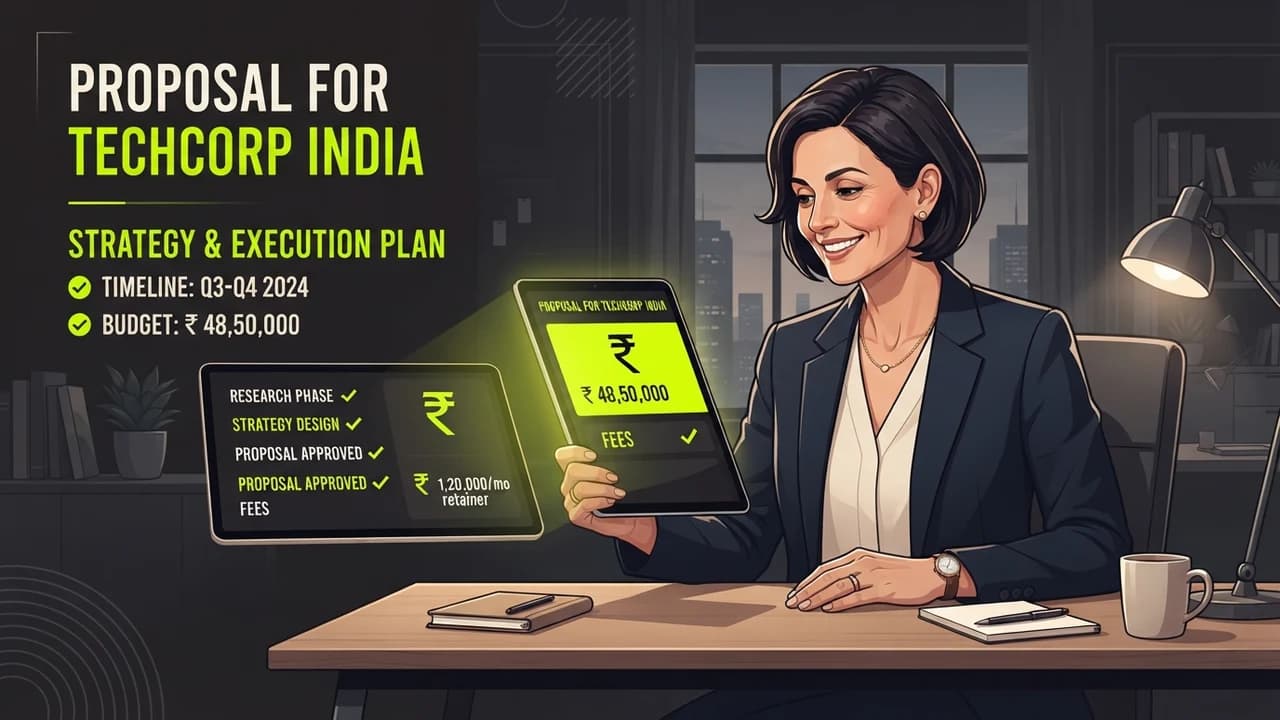
Indian marketing and design agencies can cut proposal turnaround times from two days to five minutes using automated AI drafting workflows — increasing pitch closing rates by 35% through tailored scope clarity.
Writing custom client proposals is one of the biggest administrative drains on an agency team. After conducting an exhaustive discovery call, account executives often spend four to eight hours drafting project scopes, outlining deliverables, calculating rate cards, and assembling slide decks. Because the process is exhausting, agencies either send generic copy-paste templates that fail to resonate, or they take 48 hours to respond — by which time the client has already engaged a faster competitor.
The Flaw of Traditional Agency Proposal Drafting
When proposal assembly relies on manual typing and fragmented document templates, agency pipelines suffer three predictable problems:
- Slow turnaround speed: Sales momentum cools rapidly. A proposal delivered in 2 hours closes at twice the rate of one delivered in 3 days
- Generic template syndrome: Clients immediately detect boilerplate text, eroding perceived value and triggering aggressive price haggling
- Scope creep vulnerability: Vaguely phrased deliverable descriptions lead to painful unbilled client revision rounds later in the project lifecycle
Deploying a structured no-code AI proposal workflow solves all three issues simultaneously.
The 4-Step 5-Minute AI Proposal Workflow
Step 1: Capture Raw Discovery Notes via Audio Transcription
During your client discovery meeting, record the conversation with the client's permission using tools like Otter.ai, Fireflies.ai, or Google Meet's built-in transcription.
The audio transcription captures the authentic vocabulary of the client:
- Their exact business pain points and missed revenue targets
- Their previous disappointing experiences with other agencies
- Their stated budget expectations and target launch timelines
Why Using the Client's Exact Words Maximizes Conversions
Clients do not buy agency jargon; they buy solutions to their self-described problems. When your proposal mirrors their exact phrases back to them in the problem statement, they feel understood on an instinctive level.
Step 2: Feed the Transcript into a Structured Prompt Template
Paste the raw conversation transcript into your AI engine (such as Claude Pro or ChatGPT Team) paired with your standardized Agency Master Framework prompt.
The system prompt contains your agency's permanent DNA:
- Standard service packages and pricing tiers
- Clear revision limits and delivery milestones
- Terms of service, payment schedules (50% upfront, 50% upon completion), and GST details
The Instruction Directive:
Extract the client's primary objective from the transcript. Match their requirements to our Tier 2 Performance Marketing Package. Draft a 3-page customized scope document detailing: Executive Summary, Proposed Deliverables, 90-Day Milestone Roadmap, and Investment Breakdown. Adopt a confident, authoritative tone.
Step 3: Instant Generation of the Bespoke Scope of Work
Within 45 seconds, the AI outputs an executive proposal tailored specifically to the client's situation:
- The Executive Diagnosis: Summarizes the client's current bottleneck using their own vocabulary
- The Scope Architecture: Clear, bulleted deliverables that leave zero ambiguity regarding what is included and excluded
- The Phased Roadmap: Visual 30-60-90 day milestone schedule outlining exact review checkpoints
- The Commercial Investment: Clear rupee pricing with transparent payment milestones and GST schedules
Step 4: Rapid Human Review & One-Click PDF Export
The account lead spends three minutes reviewing the generated copy, verifying specific commercial terms, and adjusting minor nuances. The approved text is pushed automatically via Make.com or n8n into a polished PandaDoc, Google Docs, or Notion proposal template with your brand styling, ready to send to the client.
Total time elapsed from discovery call to client inbox: under 15 minutes.
Performance Metrics: Manual Proposals vs Automated AI Engine
Operational Metric | Manual Proposal Assembly | Automated AI Proposal Workflow |
|---|---|---|
Average Turnaround Time | 24 to 48 hours | 5 to 15 minutes |
Staff Hours per Proposal | 4 to 6 hours | 5 minutes of review |
Personalization Level | Low (recycled boilerplate) | High (mirrors client's transcript) |
Proposal-to-Close Conversion Rate | 18% – 22% | 34% – 42% |
Scope Dispute Incidents | Frequent (vague language) | Rare (explicit deliverable limits) |
Transforming Operational Speed into Competitive Advantage
In competitive B2B markets, speed is a proxy for competence. When a prospective client finishes a morning discovery call and receives a bespoke, beautifully structured proposal before lunch, your agency stands out as extraordinarily professional, decisive, and organized.
The team at Zero To AI builds practical automation frameworks and step-by-step guides for non-coder founders and agency operators. Discover how to streamline your service business operations at [zerotoai.in](https://zerotoai.in).
Frequently Asked Questions (PAA)
Can AI accurately price complex custom agency projects?
Yes, provided you establish clear pricing parameters in your master system prompt. You can define base retainer fees, hourly add-on rates, and minimum project thresholds so the model calculates accurate investment tiers based on project scope.
Is client confidential information safe when using AI transcription tools?
Ensure your agency uses enterprise AI accounts (such as ChatGPT Team or Claude Pro) that explicitly state your inputs are not used for public model training. You can also run lightweight local Whisper models on your private computer for complete data privacy.
What is the ideal length for a digital agency proposal?
For small and mid-tier projects (₹50,000 to ₹3,00,000), keep proposals between 2 and 4 pages. Long 20-page decks delay decision-making; decision-makers primarily want clear problem diagnosis, concrete deliverables, timeline milestones, and investment numbers.
How do automated proposals prevent scope creep?
AI proposal workflows enforce standardized boundary clauses across every document: explicitly defining included revision cycles, file handoff formats, and standard hourly rates for out-of-scope requests, protecting agency margins from project inflation.
Learn to build AI workflows that handle your busywork — live sessions, real projects, zero code.
See the courseBeginner-friendly