.jpg&w=1080&q=75)
Chatbots Are the New Clippy: The Shift to Passive Agents & Systems of Action

Chatbots Are the New Clippy: The Shift to Passive Agents & Systems of Action
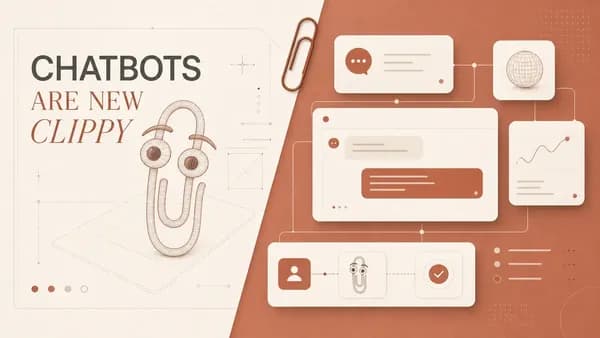
In the late 1990s, Microsoft introduced Clippy, an animated paperclip designed to assist users. If you started writing a letter, Clippy would pop up and say, "It looks like you're writing a letter. Would you like help?" While well-intentioned, Clippy became a symbol of intrusive, shallow assistance because it didn't actually do the work—it just interrupted you to ask questions.
Three decades later, the modern AI chatbot is beginning to feel remarkably like Clippy.
We are currently in a transition phase. The initial excitement of talking to an LLM is fading, and business owners are realizing that copying and pasting text back and forth between ChatGPT and their corporate dashboard isn't automation—it's just a new form of digital admin work.
Passive chatbots are legacy tools. The next evolution of enterprise efficiency belongs to systems of action.
At Zero To AI, we train founders and operators to stop writing prompts and start orchestrating background agents. This guide details why the chatbot interface is holding your business back and how to architect autonomous workflows that execute tasks while you focus on high-level strategy.
Why Chatbots Have Reached Their Limits
A chatbot is fundamentally a reactive system. It is a conversational interface sitting on top of a database or model, completely idle until a human issues a prompt.
This model introduces several operational bottlenecks:
• The Attention Tax: Chatbots require continuous human attention. If an LLM drafts a report, you must read it, copy it, open your email client, paste it, format it, and hit send. The human remains the transfer protocol.
• Lack of State and Integration: Standard chatbots do not maintain state across systems. They don't know that a customer just filed a support ticket in Zendesk or made a purchase in Stripe unless you manually feed them the data.
• Probabilistic Friction: When a chatbot encounters a minor error or ambiguous instruction, it stops and asks for clarification, requiring constant intervention.
Because chatbots cannot act on their own, they function as advanced systems of record rather than drivers of productivity.
Understanding Systems of Action
A System of Action is an agentic AI system designed to achieve a high-level goal by executing a sequence of tasks across multiple platforms. Instead of responding to a single prompt, it listens to events, plans a multi-step execution path, calls external APIs, validates its own outputs, and self-corrects when things go wrong.
The structural difference is clear:
• Passive Chatbot: User Prompt → AI Reply → User copy-pastes to CRM → User manually schedules task.
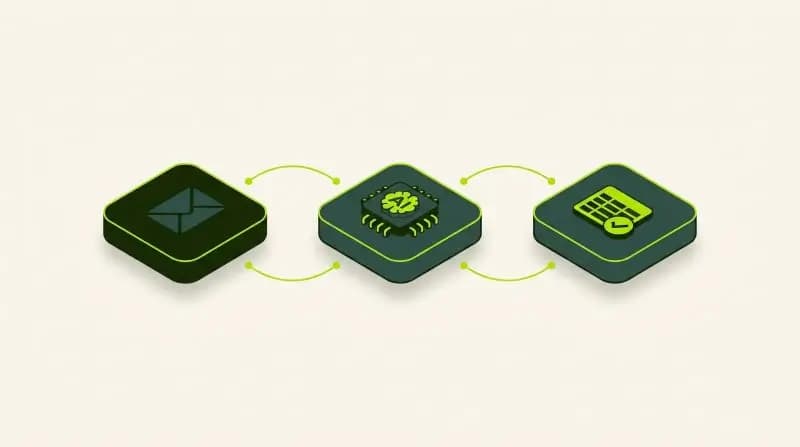
• System of Action: Webhook Trigger (e.g., New Lead Form) → AI plans context → Fetches Stripe history → Performs risk analysis → Writes data to CRM → Drafts email → Pauses for Human Gate approval → Sends email.
By shifting the control plane from human-driven prompts to event-driven orchestration, the AI agent becomes a digital worker that handles the operational heavy lifting in the background.
3 Core Layers of a Modern AI System of Action
Building a system of action requires moving past simple chat interfaces and setting up three foundational layers:
1. Stateful Orchestration
Unlike a chat session that starts with a blank slate, systems of action need a state manager to track progress through a multi-day or multi-step workflow. This memory layer allows the system to know where it is, what steps failed, and what parameters to pass to the next node.
2. Deterministic Guardrails
Large language models are probabilistic—they predict the next word, which can lead to unpredictable formats. A reliable system of action uses strict schema validation (such as Pydantic) to force the AI to return structured JSON. This ensures that downstream APIs receive clean data and do not crash.
3. Human-in-the-Loop (HITL) Checkpoints
Autonomy does not mean lack of control. High-value systems of action use a hybrid model. The agent executes 90% of the research, data gathering, and drafting, but pauses at a designated "Human Gate" (like a Slack button or a web dashboard) for final approval before executing a write action like sending a payment or publishing content.
How to Get Started: The Zero To AI Roadmap
If you want to transition your business workflows from prompts to systems, start with this simple blueprint:
1. Map Your Inter-System Friction: Locate a recurring task that requires moving information across more than two applications (e.g., matching invoices in QuickBooks to Stripe transactions).
2. Deploy an Integration Engine: Use a low-code tool like n8n or a code-first framework like LangGraph to connect your systems via webhooks and API nodes.
3. Isolate the LLM to Decision Nodes: Do not use the LLM to run the entire flow. Use it only for reasoning steps—such as classifying an incoming email or extracting data from an invoice. Use clean, deterministic code for data transportation.
4. Build the Callback Checkpoint: Create an approval node. Have the workflow send you a summary of its proposed action with an "Approve" or "Reject" link.
Conclusion: The Move from Chat to Orchestration
In 2026, typing prompts is a declining skill. The highest-leverage skill in the agent economy is orchestration—the ability to connect models, databases, and APIs into a unified system that operates on autopilot.
By building systems of action, you move your team away from manual data entry and into roles where they act as supervisors of automated departments.
Ready to build systems that work while you sleep?
[Subscribe to the Zero To AI Newsletter] to get step-by-step guides, workflow templates, and case studies on how modern companies are deploying autonomous workflows.
Learn to build AI workflows that handle your busywork — live sessions, real projects, zero code.
See the courseBeginner-friendly