.jpg&w=1080&q=75)
The 'Harness Engineer': Why the Best AI Orchestrators Aren't Computer Scientists

The 'Harness Engineer': Why the Best AI Orchestrators Aren't Computer Scientists
In the early days of generative AI, the tech world was convinced that everyone needed to learn how to code. We saw the rise of the "prompt engineer"—individuals who spent their days trying to find the magic sequence of words that would get a model to output the perfect response.
But as artificial intelligence matured, we realized that prompt engineering was just a temporary bridge. Typing instructions into a chat box is a low-leverage skill that is quickly being automated.
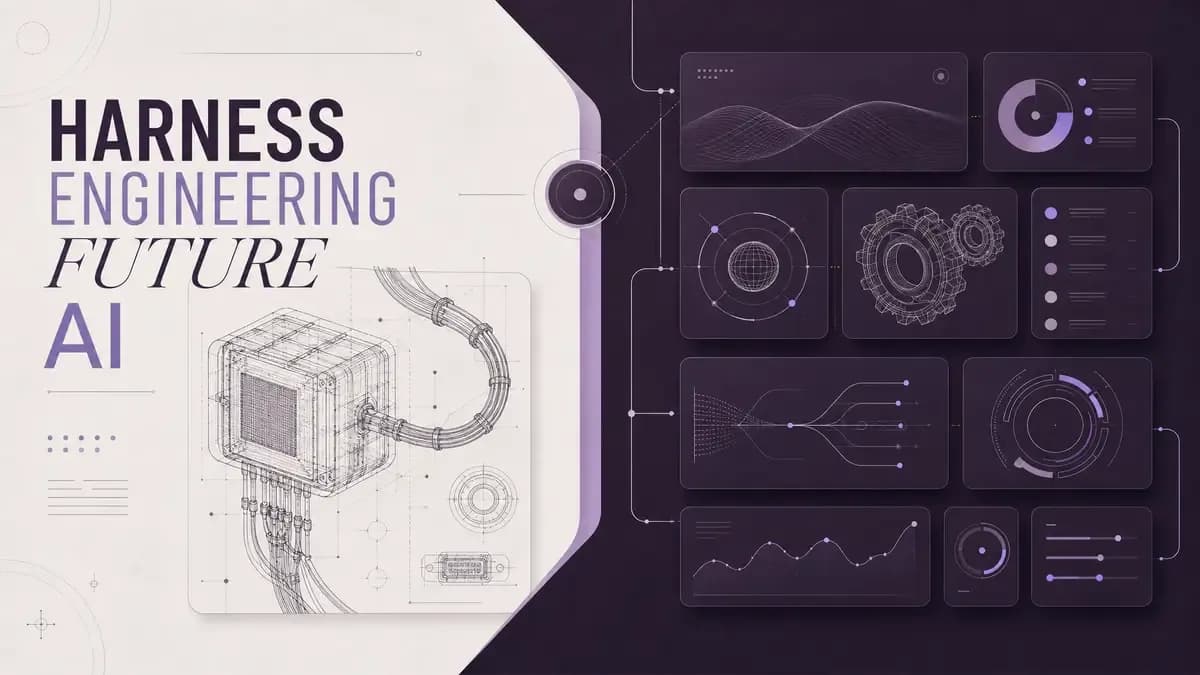
Today, the industry is entering its next phase: Harness Engineering.
Surprisingly, the people building the most effective agentic systems in this phase aren't computer scientists or software engineers. They are domain experts, project managers, and business operators.
At Zero To AI, we teach professionals how to transition from prompt writing to system orchestration. This guide explains what harness engineering is and why subject matter experts are uniquely positioned to dominate the agent economy.
The 3 Phases of AI Development
To understand where the market is going, we must look at the three evolutionary phases of building with AI:
1. Prompt Engineering (Language & Phrasing): Crafting text prompts to get a single output from an LLM. This is a manual, one-off task.
2. Context Engineering (Data & Memory): Designing systems that retrieve the correct data (RAG) and maintain chat history so the AI has context.
3. Harness Engineering (Systems & Environments): Building the infrastructure around the AI model—including tool-calling abilities, state management, validation logic, and error recovery—so it can execute workflows autonomously.
[Prompt Engineering] (Telling the AI what to do)
        │
        ▼
[Context Engineering] (Giving the AI the right info)
        │
        ▼
[Harness Engineering] (Building the environment where the AI can work)
What is a "Harness" in AI?
A "harness" is the system of rules, tools, and connections that surrounds an AI model. Think of a physical harness used to steer a powerful animal. Without it, the animal's power is uncontrollable. With it, you can steer that power to plow a field or pull a carriage.
Similarly, an AI harness provides the structural rails that channel an LLM's raw intelligence into predictable business outcomes.
A harness consists of:
• Tool Connections: Giving the agent access to APIs, databases, and spreadsheets.
• State Management: Keeping track of progress during long-running tasks.
• Validation Logic: Using deterministic code to check if the AI's output is correct before sending it to a customer.
• Recovery Routing: Instructing the agent on what to do when an API fails (e.g., "try again with different parameters" or "alert a human").
Why Subject Matter Experts Excel as Harness Engineers
Writing code is no longer the bottleneck. With modern visual orchestration platforms like n8n and drag-and-drop agent builders, the mechanical part of connecting systems has become accessible to everyone.
The real bottleneck is system logic and domain expertise—areas where non-technical operators shine.
1. They Know the Business Logic
A software engineer knows how to write clean code, but they often don't understand the nuances of a supply chain, a marketing funnel, or a corporate compliance audit. A domain expert understands the exact step-by-step logic required to complete a business process. Because a harness is simply a translation of business logic into a system, the person who knows the process is best equipped to build it.
2. They Possess "Human Taste"
AI can generate content, but it cannot judge quality. It lacks context, empathy, and brand alignment. Subject matter experts have the trained eye (or "taste") required to set the standard for what is acceptable. They are the ones who design the Human-in-the-Loop gates, ensuring the AI's outputs match the company's standards before execution.
3. They Think in Logical Workflows
Harness engineering is about mapping dependencies: If X happens, check Y. If Y is valid, execute Z; otherwise, route to human. This is project management, not advanced calculus. Operators who are skilled at creating SOPs (Standard Operating Procedures) are natural system architects.
How to Upskill into Harness Engineering
If you want to transition from a passive user of AI to an active architect of autonomous systems, follow this roadmap:
1. Master Workflow Mapping: Stop looking at AI tools. Open a whiteboard tool and map out your company's manual processes as node-based flowcharts.
2. Learn Low-Code Orchestration: Spend time understanding how to connect APIs using platforms like n8n or Make. Learn how webhooks work and how data is transferred via JSON.
3. Focus on Quality Control: Study how to build evaluation loops. Set up criteria to test if your agents are producing consistent results under different scenarios.
Conclusion: The Era of the Orchestrator
In the agent economy, the value has shifted from the underlying model to the orchestration layer. The future belongs to the Harness Engineer—the operator who can design the rules, connect the tools, and set up the safety guardrails.
You do not need a computer science degree to build these systems. You need logical thinking, deep industry knowledge, and the willingness to transition from prompt engineering to system orchestration.
Ready to become an AI Orchestrator?
[Explore our Zero To AI Workshops] and learn how to build production-grade agentic systems using n8n and low-code orchestration frameworks.
Learn to build AI workflows that handle your busywork — live sessions, real projects, zero code.
See the courseBeginner-friendly