.jpg&w=1080&q=75)
Human-in-the-Loop AI Workflows: The Trust but Verify Guide

Human-in-the-Loop AI Workflows: The Trust but Verify Guide
You click "run" on a fully autonomous agent. It starts writing emails, sorting tickets, or publishing posts. For the first ten minutes, you feel like a genius who has finally solved scale. Then, a silent hallucination slips through. An AI agent sends a nonsensical message to a VIP client or refunds a customer ten times the purchase price.
This is the hidden cost of pure automation. It is why smart operators are shifting away from hands-off bots and toward human in the loop ai workflows.
By inserting structured checkpoints into your automation pipelines, you get the leverage of artificial intelligence with the safety and high taste of human curation. Here is how to design a "trust but verify" system that protects your brand without slowing down your business.
The Hidden Trap of Pure AI Automation in Business
Pure AI automation is intoxicating. It promises to clear your inbox, draft your blogs, and handle your operations while you sleep. But when you completely remove humans from the process, you run into the "taste decay" problem.
Without human guidance, AI outputs default to average. They lose original voice, rely on repetitive clichés, and fail to catch subtle nuances that a human editor spots instantly. In the worst cases, they hallucinate facts or leak internal data.
When an AI failure happens in public, the damage to your brand is immediate. A single bad response can wipe out months of trust. That is why fully autonomous execution should be reserved for low-risk, internal tasks. For anything client-facing, high-value, or legally binding, a hybrid approach is mandatory.
Understanding the Control Spectrum: HITL vs. HOTL
To design secure automation, you must understand the difference between the two primary hybrid control models:
• Human-in-the-Loop (HITL): The AI cannot proceed to the next step without explicit human approval. For example, an agent drafts a reply to a billing dispute, but the message sits in a queue until a support rep reviews and clicks "Send."
• Human-on-the-Loop (HOTL): The AI executes tasks autonomously, but a human monitors the system in real-time and holds veto power. For instance, an agent writes and schedules social posts, and you review the queue once a day to delete or edit anything off-brand.
Key Insight: Choose HITL for high-risk operations where a single error is catastrophic (e.g., executing refunds or updating database records). Choose HOTL for high-volume, low-risk pipelines where speed is the primary bottleneck (e.g., initial email sorting or drafting internal summaries).
The Step-by-Step Blueprint for Designing HITL Gates
Inserting a human gate does not mean you have to babysit every single transaction. A well-designed workflow uses conditional routing to flag only the items that need attention. Here is how to build that logic:
1. Define Your Risk Boundaries: Identify which steps in your pipeline can cause damage. These are your mandatory HITL gates.
2. Use Confidence Score Thresholds: Program your LLM nodes to return a confidence score alongside their output. If the model's confidence falls below a set threshold (e.g., 80%), automatically route the task to a manual review queue.
3. Implement Edge-Case Escalation: Create regex filters or classifier prompts to spot high-risk keywords (e.g., "cancel subscription," "sue," "legal action"). Route these cases to a high-priority channel instantly.
By setting up these filters, your team only reviews a fraction of the total workflow, preserving 90% of the time-saving benefits of AI while maintaining complete control.
How to Build Async HITL Gates Without Complex Code
You do not need a team of software engineers to build reliable human-in-the-loop gates. Modern workflow builders make it easy to set up asynchronous approval loops using three tools:
• n8n (Orchestrator): The brain of your workflow. n8n runs the agent, calls the LLM, checks conditions, and pauses execution.
• Slack or Microsoft Teams (Interface):The alerting layer. n8n posts a message containing the AI's draft and interactive "Approve" or "Edit" buttons using Slack's Block Kit. This is particularly useful in agentic customer support setups.
• Airtable or Google Sheets (Queue): The database. If you prefer a visual dashboard over chat notifications, route drafts to a spreadsheet where you can review them in bulk.
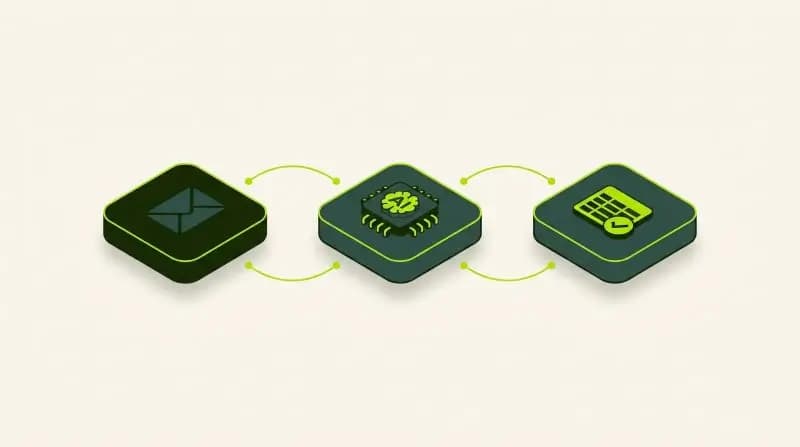
The flow is simple: the AI drafts the content, n8n writes it to your queue, and pauses. When you click "Approve" in Slack or update a row in Airtable, a webhook sends a payload back to n8n, which wakes up and pushes the task to completion.
Tracking the Metrics That Matter: AI Governance & ROI
An unmonitored pipeline is a liability. To prove the ROI of your hybrid system, you need to track how well your humans and agents are working together:
• Approval Rate: The percentage of AI drafts sent without modifications. If this is above 80%, your prompts are highly aligned. If it drops below 50%, your context or instructions need a refresh.
• Average Edit Time: How long a human spends fixing an AI draft. If editing takes as long as writing from scratch, your pipeline is failing.
• Escalation Rate: How often the system triggers manual intervention. This helps you balance the flow of your digital workforce.
By keeping these logs, you build a clear audit trail that ensures your business stays compliant with data governance standards while scaling efficiency.
Conclusion
The future of business is not about replacing humans with machines; it is about scaling human taste through intelligent orchestration. By designing robust human in the loop ai workflows, you protect your brand from the pitfalls of pure automation while unlocking unprecedented operational leverage.
At Zero To AI, we help you design, build, and deploy these hybrid systems. We provide the templates, the prompts, and the training to turn AI from a risky experiment into a predictable, high-performing asset.
👉 Join Zero To AI today and access our complete n8n workflow blueprints for async human-in-the-loop automation.
Learn to build AI workflows that handle your busywork — live sessions, real projects, zero code.
See the courseBeginner-friendly