.jpg&w=1080&q=75)
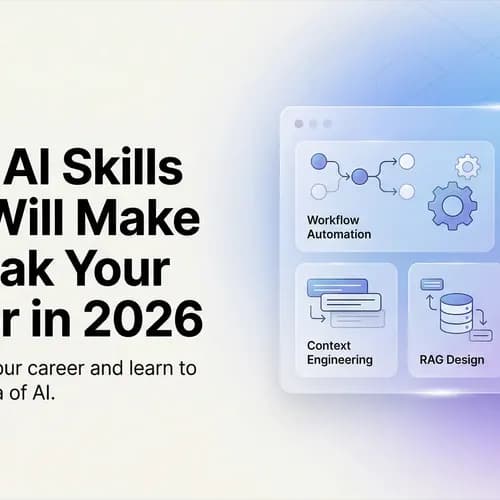
The 5 AI Skills That Will Make or Break Your Career in 2026

The 5 AI Skills That Will Make or Break Your Career in 2026
Heres the uncomfortable truth that most career advice avoids: the professionals who will thrive in 2026 arent the ones who are best at their current jobs. Theyre the ones who are best atworking with AI.
This isnt a future prediction. Its already happening. A BCG study from early 2026 found that skilled AI-augmented professionals complete complex analytical work 40% faster and with measurably higher quality than their unaugmented peers. The gap compounds every month as the tools improve.
The question isnt whetherAI skillswill matter for your career in 2026. The question is which ones.
Skill 1 — Context Engineering (The Evolution of Prompt Engineering)
Youve heard of prompt engineering. Its dead — or rather, its evolved into something far more sophisticated:context engineering.
Where prompt engineering was about finding the perfect magic words to coax outputs from a model, context engineering is aboutdesigning the entire information environmentthat an AI model reasons within. This includes:
- Curating what background information the model has access to
- Structuring the task so the model can reason in steps rather than all at once
- Knowing when to use a single model call vs. a multi-step chain
- Understanding how context windows work and how to use them efficiently
This is not a developer skill. Its a thinking skill. The best context engineers Ive seen come from backgrounds in legal writing, research, and product management — people trained to think structurally about information.
How to start: Take any piece of work you do regularly and rewrite it as a brief for an AI agent. Force yourself to be explicit about context, constraints, and success criteria. That habit of mind is context engineering.
Skill 2 — AI Workflow Automation
The most immediately valuable AI skill for most professionals isnt the most glamorous one — its the ability to buildautomated, multi-step workflowsthat connect AI models with the tools you already use.
Platforms like n8n, Make, and Zapier have become the no-code backbone of AI automation. But using them well requires something that platforms alone cant teach: the ability to map a human workflow and identify exactly where AI can add the most leverage.
The professionals getting promoted in 2026 are the ones who look at a 3-hour manual process and ask: Which of these 12 steps can an AI do in 5 seconds? Then they build it.
- A marketing manager who automated their competitive analysis workflow down from 4 hours to 15 minutes.
- An HR director who built an AI-assisted candidate screening pipeline that reduced first-round interview scheduling by 80%.
- A finance analyst who connected their data warehouse to an AI model that writes the first draft of every monthly report.
These arent engineers. Theyre domain experts who learned one new skill: how to translate their expertise into an AI-executable workflow.
How to start: Pick one repetitive task you do weekly. Build a simple 3-step automation using a free-tier tool. Iterate from there.
Skill 3 — AI Output Evaluation (Critical Review)
As AI-generated content and analysis proliferates, the most scarce and valuable skill becomes the ability toevaluatethat output critically.
This isnt about catching hallucinations (though that matters). Its about asking harder questions:
- Does this output reflect the nuance of the actual situation, or has the model over-simplified?
- Is the model reasoning from the right assumptions?
- What is this outputmissingthat a domain expert would immediately notice?
- Is the conclusion logically consistent with the evidence the model was given?
The Human Premium:AI excels at pattern synthesis across vast data. Humans excel at knowing which patternsm'atterin a specific context. That judgment is the last irreplaceable human contribution to most knowledge workflows.
Professionals who invest in deepening their domain expertise — not abandoning it for AI literacy — are the ones building the most durable career advantage.
How to start: For one week, treat every AI output you receive (from colleagues, tools, or your own prompts) as a draft that needs expert review. Write down what you changed and why. That practice sharpens a skill most people are losing.
Skill 4 — RAG Design (Connecting AI to Your World)
Retrieval-Augmented Generation (RAG)sounds deeply technical. The concept behind it is not: its the practice of connecting an AI model to a specific body of knowledge so it reasons from your data, not generic training data.
Every organization has knowledge that no AI model was trained on: internal policies, client histories, proprietary research, product documentation. RAG is how you make an AI model reason from that knowledge base rather than hallucinating answers from its training data.
The non-technical version of this skill is knowing:
- What knowledge your team has that should be fed into an AI system
- How to structure and curate that knowledge so AI can retrieve it usefully
- When to use a RAG system vs. just pasting context into a prompt
- How to evaluate whether the AI is retrieving the right information
How to start: Use a RAG-capable tool (like a private NotebookLM workspace or a custom GPT with uploaded documents) to build a knowledge assistant for one specific area of your work. Observe where it succeeds and where it fails.
Skill 5 — AI-Augmented Communication
The final and most underrated skill is the ability to use AI toimprovehuman communication — not replace it.
This means:
- Using AI to draft and thenelev'atewritten communication (making it sharper, clearer, more audience-aware)
- Using AI to synthesize research and data into presentations that tell a story rather than dump information
- Using AI to prepare for high-stakes conversations by stress-testing your arguments and anticipating objections
The trap to avoid is treating AI as a replacement for your voice. The professionals winning in 2026 use AI as a drafting engine and then apply their own judgment, tone, and relationship awareness to the final output.
Your authentic human perspective, informed by AI-enhanced research and drafting, is a more powerful combination than either alone.
The Framework: Build Your T-Shape for the AI Era
Think of your career development as building a T-shape:
- The vertical bar: Your deep domain expertise (legal, finance, marketing, engineering). This is your irreplaceable human advantage.
- The horizontal bar: Your AI literacy — the five skills above. This is the multiplier that lets you apply your expertise 10x faster and at greater scale.
A generalist who only has the horizontal bar will be replaced. A specialist who only has the vertical bar will be outcompeted. The T-shape is the only career architecture that compounds in the age of AI.
Conclusion: Dont Learn AI. Partner With It.
The professionals who treat AI as a threat to be managed will spend 2026 anxious and reactive. The ones who treat AI as a collaborator to be directed will spend it building leverage.
The five skills above arent a checklist to complete. Theyre a new way of thinking about your expertise: you are the strategist, the evaluator, the context-setter. AI is the execution engine. Together, you do what neither can alone.
Start with skill #2 this week. Build one workflow. Everything compounds from there.
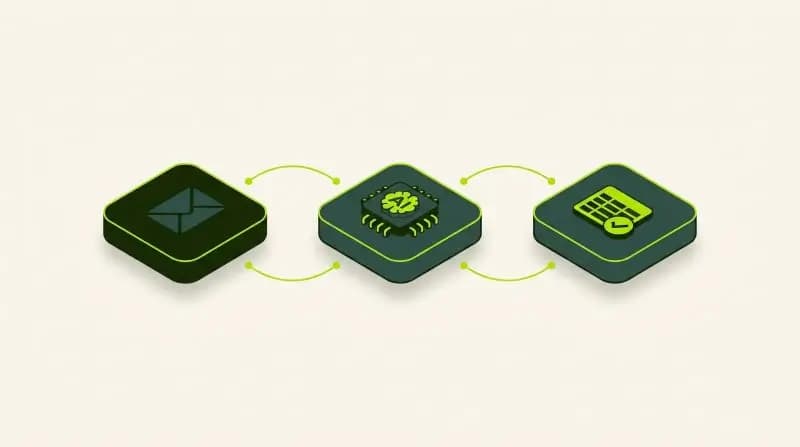
Learn to build AI workflows that handle your busywork — live sessions, real projects, zero code.
See the courseBeginner-friendly