.jpg&w=1080&q=75)
AI Skills That Actually Get You Hired: What 65% of Employers Are Looking For

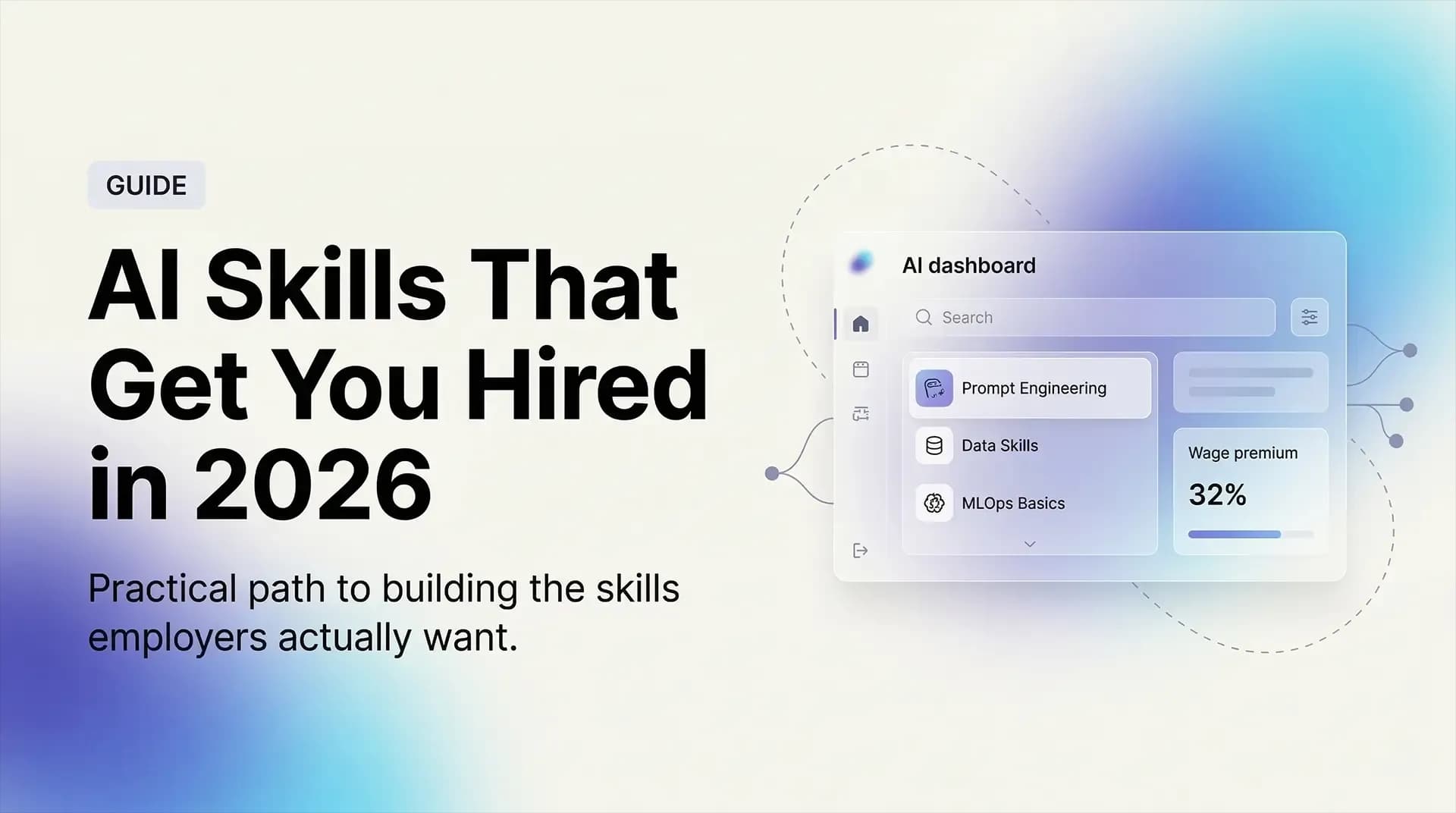
AI Skills That Get You Hired in 2026
Jobs that require AI skills now pay a 56% wage premium — up from 25% just one year ago.
That's not a rounding error. That's the difference between a $70,000 job and a $110,000 one. And it's why the question of which AI skills actually matter has never been more urgent.
The challenge? Everyone is telling you to "learn AI" — but almost nobody is telling you which skills, at what depth, for which roles. LinkedIn courses and YouTube tutorials are pointing you at everything from transformer architecture to LangChain agents, when most hiring managers just want to know you can use AI tools effectively and think critically about the output.
This article cuts through the noise. Based on current employer data, workforce research, and real job posting trends, here's what AI skills for jobs in 2026 actually look like — and a practical path to building them.
Why AI Skills Have Become Non-Negotiable in 2026
The numbers tell a clear story.
Job postings mentioning AI or AI-related terms have surged by more than 130% in the past two years. The number of workers in roles where AI fluency is explicitly required has grown from approximately 1 million in 2023 to around 7 million in 2025. That's a sevenfold increase in two years.
And yet — only 9% of organizations have reached what researchers call "true AI maturity." That gap between AI adoption and AI competence is exactly where career opportunities live right now.
"Skills demanded by employers are changing 66% faster in AI-exposed occupations than in the least-exposed roles — up from 25% the previous year." — PwC Global AI Jobs Barometer
This isn't a tech-sector phenomenon either. HR, banking, marketing, finance, project management, and accounting are all seeing a widening divide between job postings that mention AI and those that don't. The postings that mention AI consistently offer higher salaries and better growth trajectories.
The window to get ahead of this shift is still open — but it's closing faster than most people realize.
The Skill Stack: What Employers Are Actually Hiring For
Here's the practical breakdown of AI skills for jobs in 2026, organized from the most universally valued to the most specialized.
1. AI Literacy and Fluency (The New Baseline)
AI literacy has become the baseline expectation across almost every professional function. This doesn't mean you need to understand how a neural network is trained. It means you need to:
• Understand what AI tools can and cannot reliably do
• Know when to use AI assistance and when human judgment is essential
• Critically evaluate AI-generated output for accuracy, bias, and gaps
• Stay current with the tools relevant to your industry
Think of it like spreadsheet skills in the 1990s. You didn't need to build Excel — you needed to use it competently. AI literacy is that, for this decade.
2. Prompt Engineering (The Skill Everyone Underestimates)
Demand for prompt engineering has surged by 135.8% in 2026. The median total pay for prompt engineers is $126,000 per year, with experienced specialists earning $150,000 or more at top firms.
But here's what most guides miss: employers rarely want pure prompt engineers. What they want is prompt engineering + domain expertise. A marketing manager who can write high-converting prompts for campaign copy is more valuable than a generalist who knows prompting theory in isolation.
The strongest prompt engineering skills include:
• Crafting structured prompts with clear context, constraints, and output formats
• Chain-of-thought and few-shot prompting for complex reasoning tasks
• Iterative refinement — knowing how to debug a bad prompt
• System prompt design for building repeatable AI workflows
This is learnable in weeks, not months. And it transfers across every AI model and platform.
3. AI-Focused Data Skills
Data engineering sits right behind AI literacy and prompt engineering in employer demand rankings. As organizations move from AI experimentation to production deployment, they need people who can build and maintain the data pipelines that make AI actually work.
Relevant skills here include:
• Data cleaning, preprocessing, and structuring for AI consumption
• Understanding of embeddings and vector databases (for RAG systems)
• API integration — connecting AI tools to existing data systems
• Basic understanding of model fine-tuning concepts
You don't need to be a full-stack data engineer to stand out. Even understanding how data flows through an AI system puts you ahead of the majority of applicants.
4. MLOps and AI Deployment Basics
For more technical roles, the shift from "building AI models" to "deploying and scaling AI systems" is where the jobs are. MLOps — the practice of managing machine learning systems in production — has become its own career track.
Key concepts employers look for:
• Model monitoring and performance evaluation
• Version control for ML models
• Containerization basics (Docker, Kubernetes at a conceptual level)
• Cost management for cloud AI services
This is the territory of AI engineers and ML engineers, not generalists — but knowing the vocabulary and core concepts will strengthen any technical job application.
5. Human Skills That AI Cannot Replace
This one surprises people, but it's real. Research from McKinsey and LinkedIn consistently shows that the most in-demand skills in AI-exposed roles are increasingly human ones.
Leadership and cross-functional team management. Stakeholder communication. Creative thinking. Ethical judgment about AI outputs. These aren't soft skills in the dismissive sense — they're the skills that make the difference between an AI tool producing output and an organization actually benefiting from it.
"Human skills — creative thinking, resilience, flexibility, and leadership — remain critical differentiators precisely because AI cannot replicate them."
The professionals who combine AI fluency with strong communication and critical thinking are not just employable — they're increasingly hard to replace.
The Industries Where AI Skills Pay the Most
Not all industries are treating AI skills equally. Here's where the wage premium is sharpest:
Finance and Banking: AI tools for risk modeling, fraud detection, and customer analysis. AI-fluent finance professionals are commanding 35-43% pay uplifts over peers without AI skills.
Marketing and Content: Generative AI has reshaped content production, SEO, and campaign optimization. AI-literate marketers who understand both the tools and their limitations are in high demand.
Healthcare and Life Sciences: AI in diagnostics, drug discovery, and patient data analysis. Regulatory awareness paired with AI literacy is a rare and valuable combination.
Software Engineering: AI coding assistants have become standard. Engineers who know how to effectively use, review, and direct AI-generated code are more productive — and paid accordingly. Roughly half of tech roles now explicitly expect AI skills.
Human Resources: AI screening tools, workforce analytics, and skills gap analysis. HR professionals who understand AI-driven hiring tools are increasingly sought after.
What Most Employers Are NOT Looking For (Yet)
It's worth being honest about what the current market does and doesn't reward.
Most employers — outside of specialized AI research roles — are not hiring for:
• Deep knowledge of transformer architecture or LLM training
• Ability to build models from scratch
• Advanced reinforcement learning or robotics skills
• Research-level machine learning theory
These skills matter enormously for AI research and engineering roles at companies like OpenAI, Google DeepMind, or Anthropic. But for the vast majority of the job market in 2026, they're not what's being evaluated.
The gap most people need to close is practical and operational, not theoretical.
A Realistic 90-Day Path to Hireable AI Skills
If you want to be meaningfully more competitive in the AI skills job market within three months, here's a concrete structure:
Month 1 — Foundation
• Complete one structured AI literacy course (understanding AI capabilities, limitations, and use cases)
• Start using AI tools daily in your actual work — document what works, what fails, and why
• Learn the basics of effective prompting in your domain
Month 2 — Depth
• Pick one AI tool stack relevant to your industry and go deep (not broad)
• Build a portfolio project: use AI to solve a real problem in your field and document the process
• Practice critical evaluation — take AI outputs and systematically find their flaws
Month 3 — Signal
• Update your resume with specific AI tools and accomplishments, not just buzzwords
• Contribute to one open-source project or write one case study about your AI work
• Prepare concrete interview examples: "I used AI to do X, which resulted in Y"
The professionals getting hired aren't necessarily the ones who know the most about AI. They're the ones who can demonstrate practical, measurable impact.
The Skills Gap Is Your Opportunity
Here's the uncomfortable truth that most career guides don't say out loud: the majority of professionals are not building AI skills fast enough.
Approximately 65% of workers believe their current skills will remain relevant for at least the next five years. Employer data tells a completely different story — skills in AI-exposed occupations are changing 66% faster than in non-AI roles.
That gap is not a threat to you — it's an opening.
The professionals who build practical AI skills now, while the majority is still deciding whether to take it seriously, are the ones who will own the next decade of their careers. Not because AI is magic, but because AI fluency is becoming the baseline expectation — and most people haven't cleared it yet.
Frequently Asked Questions
Do I need to know how to code to get AI jobs in 2026?
Not for most roles. AI literacy, prompt engineering, and domain expertise are in higher demand than coding for the majority of AI-adjacent positions. Technical coding skills matter more for AI engineering roles specifically.
Which AI skills should I learn first?
Start with AI literacy and prompt engineering — they transfer across every tool and role. Then add domain-specific skills relevant to your field.
How long does it take to become competitive with AI skills?
Research consistently suggests 30-90 days of focused, applied practice is enough to meaningfully differentiate yourself from peers who haven't started.
Are AI skills worth learning if I'm not in tech?
Especially if you're not in tech. AI literacy in finance, healthcare, marketing, HR, and law is often rarer and more valued than in engineering, where it's already the baseline.
What's the difference between AI literacy and prompt engineering?
AI literacy is understanding how AI systems work, what they're good at, and their limitations. Prompt engineering is the specific skill of communicating with AI effectively to get high-quality outputs. Both matter.
Start Building AI Skills That Actually Matter
The employers who are hiring right now aren't waiting for candidates with perfect credentials. They're looking for people who understand AI tools, apply them practically, and think critically about the results.
That's a learnable skill set. And it doesn't require a computer science degree.
At Zero To AI, we make AI approachable for professionals at every level — breaking down exactly which skills matter, how to build them without the overwhelm, and how to demonstrate them in ways employers actually recognize.
If you're serious about building AI skills for jobs in 2026, start with Zero To AI and go from zero to job-ready, one practical skill at a time.
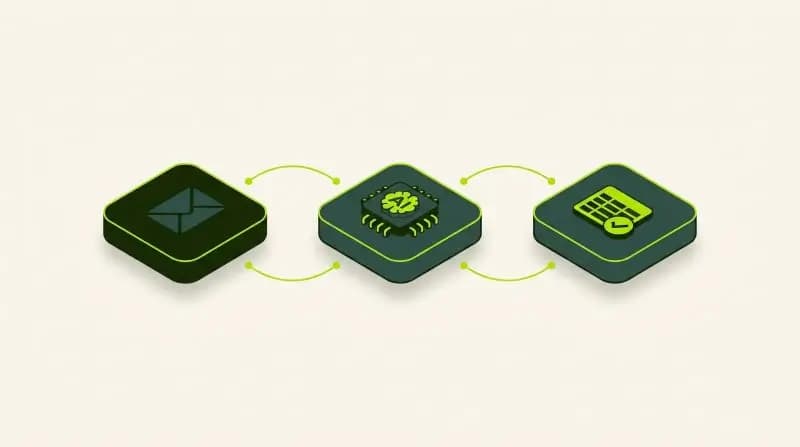
Learn to build AI workflows that handle your busywork — live sessions, real projects, zero code.
See the courseBeginner-friendly