.jpg&w=1080&q=75)
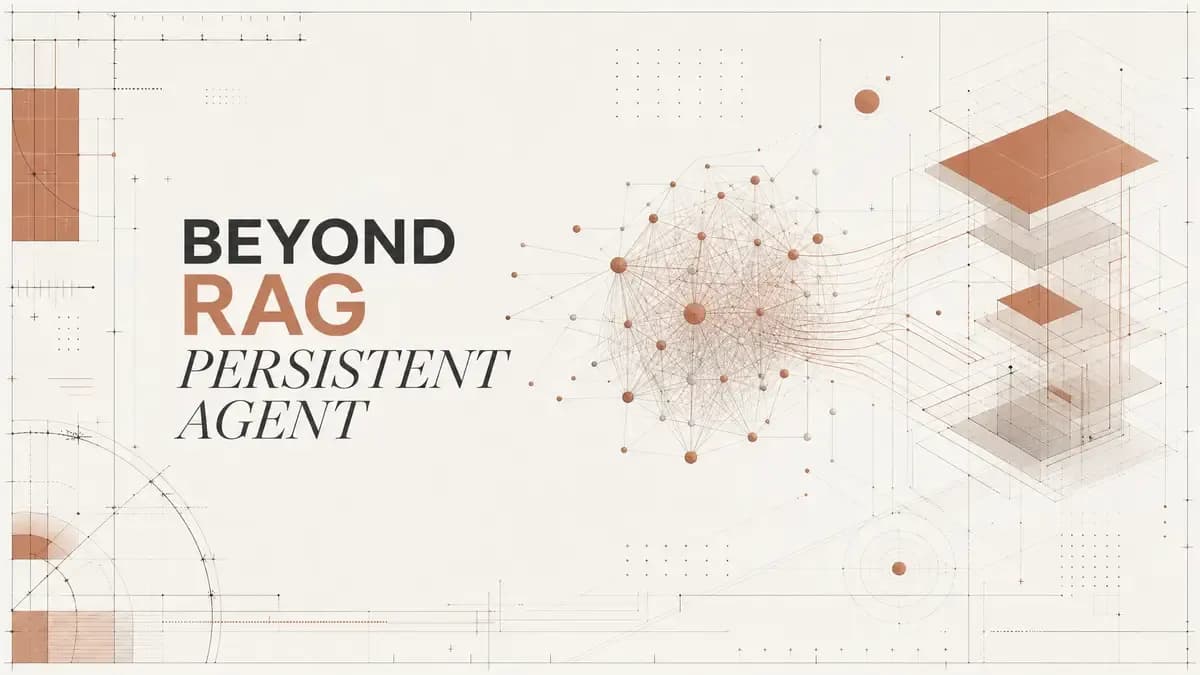
Beyond RAG: The Future of AI Agent Persistent Memory

Beyond RAG: The Future of AI Agent Persistent Memory
If you build an AI assistant using standard Retrieval-Augmented Generation (RAG), you will quickly hit a wall. Your assistant can read your documentation and answer questions, but it has no memory of your last conversation. If you tell it your name, your preferences, or a business rule, that information vanishes the second you clear the chat session. It is the digital equivalent of short-term amnesia.
To build truly autonomous assistants, you must implement ai agent persistent memory.
Moving beyond basic static document retrieval allows you to build stateful agents that remember, learn, and update their behavior over time. Here is how modern cognitive memory architectures are replacing old-school RAG.
The Breaking Point: Why Traditional RAG Fails Autonomous Agents
Traditional RAG is a read-only pipeline. When a user sends a query, the system converts it into a vector, searches a static database, pulls the top matches, and drops them into the LLM's context window. This works great for searching static manuals or FAQs.
However, autonomous agents do not just read knowledge; they execute workflows and interact with humans.
When you use RAG for interactive agents, you get "temporal blindness." RAG does not understand the chronological order of events. If a client updates their mailing address in a conversation, a RAG search will retrieve both the old and new addresses based on semantic similarity. The LLM gets confused, and the agent sends the shipment to the wrong location.
The Three-Tier Memory Taxonomy for Intelligent Agents
To build agents that can handle ongoing business relationships, we must implement a layered memory structure. Modern architectures borrow from human psychology, dividing memory into three distinct tiers:
1. Working Memory (Short-Term)
This is the active scratchpad of the agent. It contains the message history of the current session, active tool outputs, and the specific sub-tasks the agent is executing. It is ephemeral and gets wiped once the job is done to save token costs.
2. Semantic Memory (Long-Term/Factual)
Semantic memory stores static, structured facts. This includes user profiles, brand guidelines, and product pricing. Instead of searching a vector database of raw chat logs, the agent updates a structured schema (like a database row or a knowledge graph) to keep this factual knowledge clean and singular.
3. Episodic Memory (Long-Term/Experiential)
This is a chronological log of the agent's past experiences. It remembers what tools it called, what the outcomes were, and whether the user was satisfied. By querying its episodic memory, a multi-agent system can "remember" that a certain API call failed yesterday and try a different route today.
Advanced Frameworks Shaping 2026 Memory Architectures
Developers are moving away from writing custom database-sync scripts to manage agent states. A new class of specialized libraries has emerged to handle long-term persistence:
• Mem0: A smart memory layer that automatically extracts facts and preferences from conversations and updates them dynamically (e.g., changing "likes coffee" to "prefers tea" based on user inputs).
• Letta: Designed to give LLMs a persistent virtual file system, allowing agents to write data to long-term memory blocks without cluttering the active context window.
• Graphiti: A temporal knowledge graph engine that links facts, events, and relations together with chronological timestamps.
Implementing these tools ensures your agents have a consistent, queryable brain rather than an unorganized list of chat logs.
How to Implement Active Memory Read, Write, and Forget Rules
Giving an agent memory does not mean saving every word. If your agent remembers every sentence a user speaks, your token usage will skyrocket, and your context window will drown in noise. You must establish strict memory gates:
Key Rule: Memory must be actively managed. Implement a classification step at the end of every conversation: "Did the user state a permanent preference, a factual update, or an event-based outcome?" If yes, write it to Semantic or Episodic memory. Otherwise, discard it.
Additionally, build in invalidation windows. If an event log is older than 30 days, or if a user overrides an old preference, program the database to purge or archive the record.
Conclusion
The transition from static retrieval to dynamic, stateful continuity is the defining shift in agent development today. By integrating robust ai agent persistent memory, you elevate your AI from a simple search assistant to a reliable, long-term business partner.
At Zero To AI, we help you implement advanced cognitive memory layers in your business workflows. We make sure your agents have the memory capacity to act autonomously, securely, and with high brand alignment.
👉 Join Zero To AI today to learn how to implement stateful memory in your agentic workflows.
Learn to build AI workflows that handle your busywork — live sessions, real projects, zero code.
See the courseBeginner-friendly