.jpg&w=1080&q=75)
The Death of Prompt Engineering: Why \'Reasoning\ is the New Skill of 2026

For nearly three years, the tech world was obsessed with \'Prompt Engineering.'\ We were told that the ability to write 500-word instruction sets with the \'perfect\ adjectives was the most valuable skill of the century. But in 2026, the gold rush is over. Today, the \'perfect prompt\ is being replaced by something far more powerful:AI reasoning skills.
If you’re still trying to master the precise phrasing of a prompt, you’re learning a language that the AI no longer needs you to speak.
Why Your \'Perfect Prompt\ is Already Outdated
The rapid evolution of frontier models—from OpenAI’s o1 series to Claude’s native adaptive thinking—has fundamentally changed thefuture of AI skills. These models arent just predicting the next word; they are \'thinking\ before they speak. They use internal chain-of-thought processing to identify your intent even if your prompt is vague, incomplete, or poorly worded.
In the battle ofprompt engineering vs reasoning, reasoning has won. Modern AI agents can now write their own internal prompts, execute their own search strategies, and correct their own errors. When the machine is better at \'speaking AI\ than you ever will be, your value shifts frominputtoinsight.
What are \'AI Reasoning Skills\?
So, if prompting is dead, what replaces it? The answer isAI reasoning skills—the ability to structure a problem, define logic, and set constraints that an autonomous agent can follow.
Think of the relationship like an architect and a builder. The \'Prompt Engineer\ was the builder, meticulously following instructions on where to place every brick. The \'Reasoning Architect\ is the one who designs the blueprint, ensures the physics work, and understands the ultimate purpose of the building. In 2026, you arent an instruction-giver; you are a logic-architect.
From Speaking AI to Directing AI
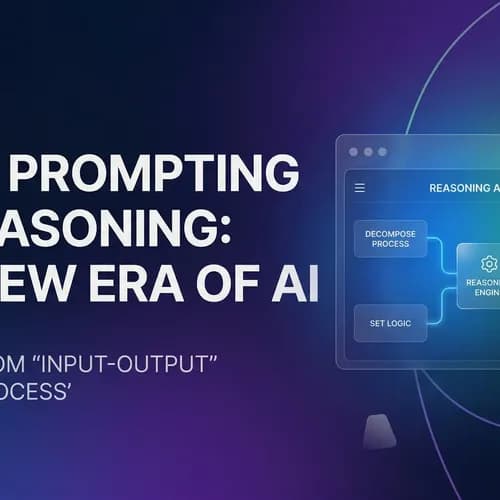
We have moved from the era of \'Input-Output\ to the era of \'Goal-Process.'\ As the AI becomes more agentic, your role shifts fromdoingtodirecting. An AI Orchestrator doesnt spend hours tweaking a phrase; they spend minutes defining the success criteria of a goal.
This requires a deep understanding of process decomposition—breaking a complex business problem into smaller, logical steps that an AI can reason through autonomously. If you can’t explain the logic of your business process to a human, you can no longer command the AI to execute it.
3 Ways to Train Your \'Reasoning Muscle\
If you want to stay ahead of the curve, you need to transition tolearning AI reasoning. Here are three ways to start:
- First-Principles Thinking:Stop copying prompts from the internet. Start questioning the absolute core truths of the problem youre trying to solve. Why does this task exist? What is the irreducible minimum requirement for success?
- Process Decomposition:Practice breaking every task you do down into a logical flowchart. Use tools like Mermaid.js or even a simple whiteboard. If you can’t map the logic, the AI cant reason through it.
- Adversarial Logic:Instead of telling the AI what to do, tell it how it is likely to fail. Building logical \'guardrails\ throughAI logic trainingis more effective than any 1,000-word prompt.
The New Hierarchy of Work: Logic, Ethics, and Orchestration
The \'Zero To AI\ skills stack has officially flipped. While technical execution (coding, writing, designing) is being commoditized by autonomous agents, human-led orchestration is more valuable than ever.
We are moving toward a world where your career isnt built on what you canbuild, but on what you canconceptualize and govern. The human provides the \'Why\ and the \'Should,'\ while the AI provides the \'How.'\
Conclusion / CTA
Dont learn to talk to the machine—learn to think with it. The transition from Prompting to Reasoning is the bridge that takes you from a user to an orchestrator.
Is your team ready for the Reasoning Era?Join our\'Logic & Orchestration Workshop\at Zero To AI to master the frameworks that will define the next decade of professional success.
FAQ (People Also Ask)
- Do I still need to know how to prompt?Basic prompting is still useful for simple interactions, but it is no longer a high-value professional skill.
- How can I improve my AI reasoning?Focusing on formal logic, critical thinking, and structured problem-solving frameworks like McKinsey’s MECE.
- What are reasoning-native models?Models like OpenAI o1 or Claude 4.5+ that use extended compute time to process logic internally before generating a response.
Learn to build AI workflows that handle your busywork — live sessions, real projects, zero code.
See the courseBeginner-friendly