
Free AI Courses in India (2026): Best Options for Non-Technical Professionals

Free AI Courses in India 2026: Best Options for Non-Technical Professionals
The best free AI courses in India for non-technical professionals in 2026 include Google AI Essentials, Microsoft AI Fundamentals, Zero To AI Free Mini-Course, and IBM AI Foundations. These programs teach practical workflow automation, workplace prompt engineering, and everyday business applications without requiring Python coding, machine learning mathematics, or computer science degrees.
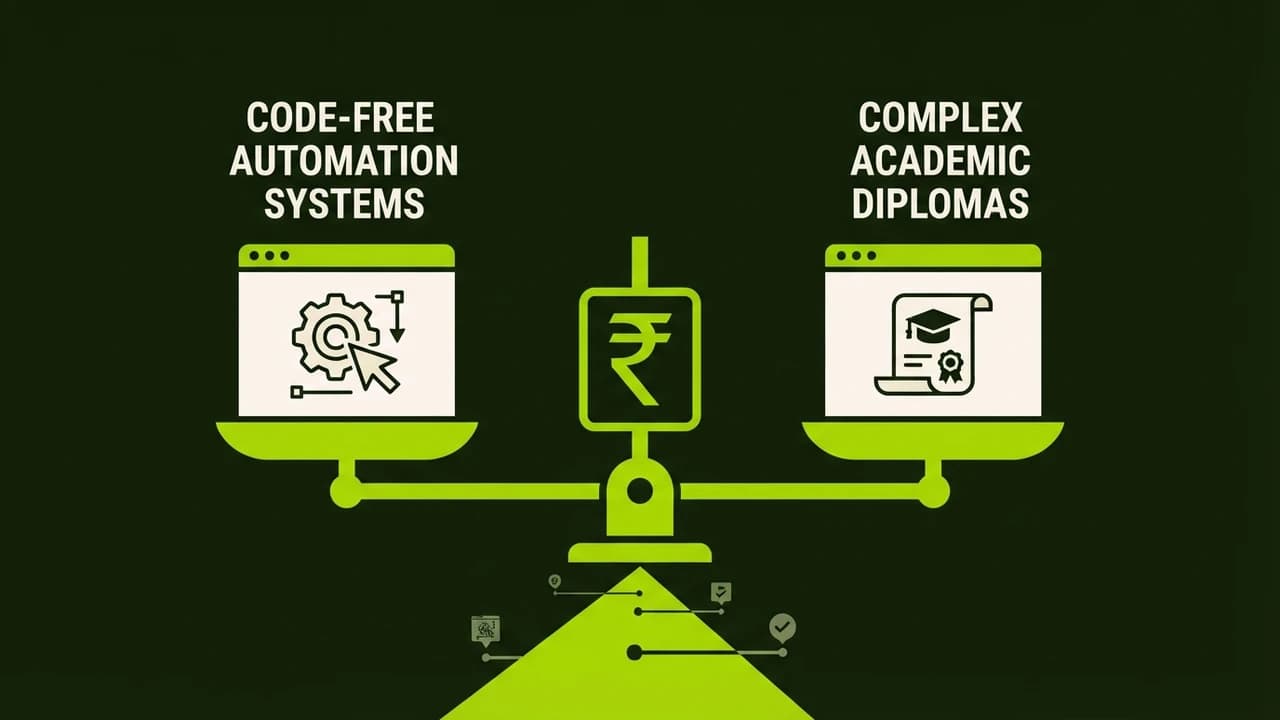
Across Indian corporate hubs like Mumbai, Bengaluru, Gurugram, Hyderabad, and Pune, thousands of salaried employees and small business operators want to upskill. Most university certifications demand ₹50,000 to ₹1,50,000 for technical curriculums heavy on Python syntax, linear algebra, and data science theory. For an HR manager, marketing specialist, accountant, or sales executive, those technical topics fail to address daily office tasks. Non-technical workers do not need to build algorithms from scratch. They need to automate repetitive reporting, draft communications, extract invoice data, and optimize operations using no-code tools.
This guide reviews the top free AI courses for Indian professionals, detailing curriculum coverage, time commitment, certificate options, and workplace relevance.
Why Non-Technical Indian Professionals Need Practical AI Over Coding
A widespread misconception across Indian corporate circles is that learning AI requires programming expertise. Many professionals enroll in beginner Python courses, only to quit after three weeks because debugging syntax has little connection to their actual job responsibilities.
In an Indian office, productivity depends on managing communication, processing documentation, analyzing spreadsheets, and coordinating projects. Here is why practical workflow AI education delivers immediate returns compared to theoretical programming courses:
- Immediate Task Automation: Structuring advanced prompts in ChatGPT, Claude, or Google Gemini helps you draft proposals, summarize minutes, and analyze trends in minutes instead of hours.
- Zero Software Engineering Overhead: Modern AI tools operate through conversational interfaces and visual workflow builders. You can build internal document search assistants without touching a terminal.
- Protection Against Routine Automation: Repetitive data entry and report compilation are being automated across Indian IT services, banking, and retail. Professionals who supervise AI systems stay relevant and secure promotions.
- Faster Time to Value: A practical no-code workflow course helps you automate an existing office process within one weekend, whereas mastering Python requires months of study.
The 5 Best Free AI Courses in India for Non-Coders (2026)
The following courses offer free enrollment or audit options, require zero technical background, and provide actionable skills for Indian workplace environments.
1. Google AI Essentials (Coursera Financial Aid or Audit)
Google AI Essentials is a foundational nine-hour course created by Google product experts to introduce generative artificial intelligence to non-technical workers.
- Curriculum Overview: Covers fundamentals of generative AI, practical prompting strategies, using AI tools for everyday workplace productivity, recognizing bias, and using AI responsibly.
- Time Commitment: 9 to 10 hours of self-paced video lessons and interactive quizzes, typically completed over two weekends.
- Certificate Availability: Free to audit for full content access. Learners seeking a verifiable digital certificate for LinkedIn can apply for Coursera Financial Aid, which is widely granted to Indian applicants within 15 days.
- Relevance for Indian Professionals: Ideal for beginners who want a recognized credential on their resume. Modules demonstrate how to draft emails, summarize customer feedback, and create presentation outlines using Gemini and Google Workspace.
2. Microsoft Career Essentials in Generative AI (LinkedIn Learning and Microsoft Learn)
Co-developed by Microsoft and LinkedIn, this free learning pathway provides a structured introduction to workplace artificial intelligence.
- Curriculum Overview: Includes five core modules focusing on generative AI concepts, Microsoft Copilot functionality, ethical considerations, search engine evolution, and workplace productivity strategies.
- Time Commitment: Approximately 4 to 5 hours of total learning time.
- Certificate Availability: Completely free. Upon completing all five modules and passing the final assessment, you receive an official Microsoft Career Essentials certificate directly linked to your LinkedIn profile.
- Relevance for Indian Professionals: Because most Indian enterprises and multinational corporations run on Microsoft 365, learning how Copilot operates across Word, Excel, and Outlook provides immediate workplace utility.
3. Zero To AI Free Mini-Course: Practical AI for Non-Technical Professionals
The Zero To AI Free Mini-Course is built specifically for Indian non-coders who want to build real workplace automations without foreign case studies or programming jargon.
- Curriculum Overview: Focuses on practical business use cases, including structuring prompt chains for business proposals, setting up no-code automated workflows with n8n and Make, extracting financial data from GST receipts, and handling customer correspondence over WhatsApp.
- Time Commitment: 2 to 3 hours of focused video training with step-by-step templates and prompt libraries.
- Certificate Availability: Free digital certificate of completion upon finishing the practical workflow challenge.
- Relevance for Indian Professionals: Grounded directly in Indian market conditions. Examples feature Indian Rupee numbers, local business dynamics, GST compliance, and domestic communication channels like WhatsApp.
4. IBM AI Foundations for Everyone (edX and Coursera Audit)
IBM offers a three-course series designed to demystify artificial intelligence for business professionals.
- Curriculum Overview: Covers foundational AI concepts, real-world industry applications, generative AI capabilities, and identifying automation opportunities.
- Time Commitment: Approximately 10 to 12 hours across three short courses.
- Certificate Availability: Free to audit. Paid verified certificates are optional or available via financial aid.
- Relevance for Indian Professionals: Useful for operations heads and managers evaluating vendor AI proposals or departmental automation.
5. Elements of AI (University of Helsinki)
Elements of AI is a well-known introductory course built to explain artificial intelligence concepts to general audiences.
- Curriculum Overview: Explores core AI concepts, neural networks, and real-world societal impact without programming.
- Time Commitment: 12 to 15 hours of self-paced reading and exercises.
- Certificate Availability: Free digital certificate upon completing exercises.
- Relevance for Indian Professionals: Ideal for professionals seeking clear conceptual understanding of algorithms without mathematics.
Free vs Paid AI Learning Paths in India
Before investing personal savings into expensive corporate bootcamps or university executive diplomas, evaluate how free learning paths compare against paid programs:
Evaluation Criteria | Free Self-Paced Courses | Paid Executive University Diplomas | Practical No-Code Programs (Zero To AI) |
|---|---|---|---|
Average Cost in INR | ₹0 (Audit or Free Enrollment) | ₹75,000 to ₹2,50,000 | ₹0 to ₹3,500 (Affordable Modules) |
Coding Knowledge Needed | None | Often assumes basic Python or math | None (Strictly No-Code) |
Core Focus Area | Foundational concepts and basic prompts | Academic theory, ML math, and models | Practical workplace automations and agents |
Learning Time Required | 5 to 15 hours self-paced | 6 to 12 months part-time | 1 to 4 hours per project |
Credential Provided | Course completion badge or audit | University executive certificate | Verifiable completion certificate |
Indian Business Context | Minimal (primarily US-centric examples) | Theoretical Indian academic studies | Strong (UPI, WhatsApp, GST, INR figures) |
Hands-On Portfolio Output | Basic chat prompts and notes | Academic capstone code repository | Live deployed workflows and business bots |
Post-Course Job Utility | High for basic daily office productivity | Moderate for general non-technical roles | Immediate for daily automation and side income |
Real Indian Case Study: How a Mumbai HR Manager Saved 16 Hours Weekly
Pooja Sharma works as a Senior Human Resources Manager at a 120-person third-party logistics company in Andheri East, Mumbai.
The Workplace Problem
Every week, Pooja and her two junior recruiters spent over 20 hours reviewing resumes submitted across job portals, drafting interview invitations, answering repetitive candidate inquiries on WhatsApp, and updating Excel candidate trackers. When hiring for warehouse supervisors and customer support agents, the team received over 400 applications weekly. Reviewing candidate profiles manually caused hiring delays, and top candidates often accepted competing offers before Pooja could schedule first-round interviews.
The company management considered hiring an external recruitment agency on a monthly retainer of ₹35,000 plus GST, but budget constraints prevented approval.
The Free Learning Intervention
In early 2026, Pooja enrolled in two free courses: Google AI Essentials and the Zero To AI Free Mini-Course. Over two weekends, she committed eight hours to studying workplace prompting and visual workflow automation.
Instead of writing code, Pooja implemented a three-step practical system:
- Automated Resume Screening: She created a structured prompt template in Claude that analyzed candidate text against the company job description rubric, grading skills from 1 to 5 and flagging missing certifications.
- Standardized Communication: She used structured prompt templates to auto-draft personalized rejection notices and interview scheduling emails.
- Candidate FAQ Bot: Using a simple visual automation connector, she set up an automated WhatsApp response system that answered applicant questions about job location, shift timings, and mandatory documentation.
Measurable Results for the Company
Within four weeks, Pooja achieved clear operational improvements:
- Time Saved: Cut candidate screening time from 20 hours to 4 hours per week, saving 16 hours weekly.
- Cost Avoidance: Eliminated the need for an external hiring agency, saving ₹35,000 every month in recruitment fees.
- Candidate Turnaround: Reduced the initial application response window from 5 days down to under 4 hours.
- Total Education Investment: ₹0, accomplished entirely using free course materials and free tool trial tiers.
Pooja received a mid-year commendation from her director and was invited to train the company sales and client service teams on practical AI tools.
4 Common Mistakes Indian Professionals Make When Learning AI
Avoid these common traps that waste time and derail learning progress:
1. Starting with Python and Machine Learning Mathematics
The single biggest mistake non-coders make is buying a programming textbook or enrolling in a developer bootcamp. You do not need gradient descent, matrix multiplication, or coding syntax to use AI effectively at work. Focus first on master prompt design, document analysis, and visual automation platforms.
2. Chasing Expensive Vanity Certificates
Many private institutes charge ₹1,00,000 or more for executive certificates with university logos. Hiring managers in modern Indian businesses care about what you can actually build and automate, not a wall certificate. Demonstrating a working customer support flow or financial data extraction pipeline consistently outperforms purely theoretical credentials.
3. Treating AI as an Isolated Search Engine
Many beginners use ChatGPT like an upgraded search box for trivia. The true workplace value of generative models emerges when you provide complete source documents, establish role constraints, define output formatting, and build repeatable prompt workflows for daily tasks.
4. Overlooking No-Code Integration Platforms
Learning how to chat with an AI model is only half the solution. The real leap in business productivity happens when you connect language models to workplace tools like Google Sheets, Gmail, Slack, and WhatsApp. Platforms like n8n and Make allow non-coders to create automated pipelines without writing backend code.
Build Your First AI Agent in Just 40 Minutes at Zero To AI
Automating daily workplace tasks with artificial intelligence is the most effective way for Indian professionals to stand out, save valuable working hours, and accelerate career growth. You do not need an engineering degree, mathematical background, or expensive tuition fees to master practical AI.
At Zero To AI, we design actionable, step-by-step learning modules specifically created for non-technical Indian professionals, freelancers, and business owners.
Build Your First AI Agent in Just 40 Minutes (No Code Required)
Learn to build AI workflows that handle your busywork — live sessions, real projects, zero code.
See the courseBeginner-friendly