.jpg&w=1080&q=75)
The Ultimate Guide to Human-in-the-Loop (HITL) Workflow Design

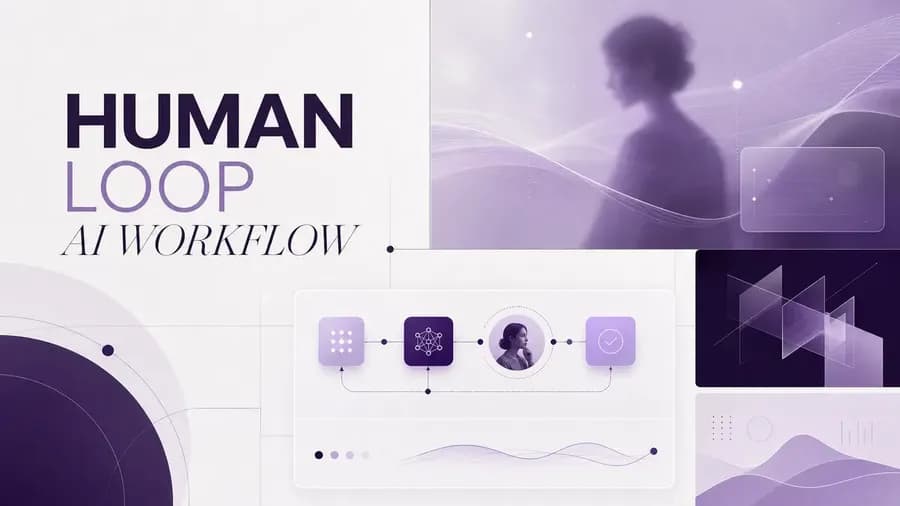
The Ultimate Guide to Human-in-the-Loop (HITL) Workflow Design
In the early days of generative AI, businesses fell in love with the idea of "100% Autopilot." We wanted systems that could scrape leads, write marketing emails, and post them directly to social media without a single human click.
But as search engines started penalizing automated spam and clients grew tired of receiving generic, hallucinated outreach, the autopilot dream broke.
In 2026, the gold standard of operations is Human-in-the-Loop (HITL) orchestration.
A Human-in-the-Loop system delegates the resource-intensive steps (research, drafting, code generation) to AI agents, but leaves the strategic decisions (taste, voice, security checks) to a human director.
At zerotoai, we design HITL systems for high-growth startups. This comprehensive guide outlines the philosophy, architecture, and step-by-step design of reliable HITL workflows.
Why "100% Autopilot" is a Liability
When you run an AI agent without human oversight, you take on three major risks:
1. The Brand Alignment Risk: LLMs excel at mimicking styles, but they do not understand your brand's underlying taste or intent. They can easily draft a tone-deaf response to a sensitive customer issue.
2. The Hallucination Wall: Even the most advanced reasoning models occasionally make up facts, cite non-existent sources, or output broken links.
3. Financial & Security Vulnerabilities: If an agent is allowed to execute API writes natively (like sending money or publishing database records) without approval, a single prompt injection or system error can cause severe damage.
By inserting a human gate, you turn the AI from an unguided ghostwriter into a highly efficient co-pilot.
The 3 Pillars of HITL Architecture
A well-designed Human-in-the-Loop system relies on three technical concepts:
1. The State Lock (Pause and Resume)
When an agent reaches a human gate, the workflow must securely save its current progress (state) to a database and pause execution. The agent should sleep—consuming no compute tokens—until a human action triggers a resume signal.
2. Contextual Notification
The system should not expect you to watch a terminal. When an agent requires approval, it should send a curated notification to where you already work (e.g., Slack, Discord, or Email) containing the exact context you need to make a decision.
3. The Re-Route Loop (Feedback Node)
A human gate shouldn't just be an "Approve" or "Reject" button. It must allow you to input feedback (e.g., "Make the intro more energetic"), which the system passes back to the drafting agent to execute a targeted revision.
Step-by-Step: Designing a HITL Content Workflow
Here is how we set up the content pipeline at Zero To AI using a three-stage approval process:
[Agent: Trend Research]
        ↓
[Agent: Topic Ideation] → [GATE 1: Topic Selection (Human)]
                                    ↓
                           [Agent: Outline Architect]
                                    ↓
                           [Agent: Copywriter Draft]
                                    ↓
                           [Agent: SEO Auditor] → [GATE 2: Editorial Review (Human)]
                                                            ↓
                                                   [Agent: Publisher (Porter)]
Gate 1: Creative Intent (Topic & Strategy)
Before writing starts, the content strategist agent (Iris) proposes 10 topics based on search trends. The human reviews the pitches, rejects the fluff, selects the top 3, and defines the target angles.
Gate 2: Quality & Tone (Draft Review)
Once the copywriting agent (Alex) drafts the piece and the auditor (Lester) verifies SEO keyword density, the draft is sent to a custom web interface. The human refines the hook, adds personal anecdotes, and validates the claims.
Gate 3: Publication Authorization (Release)
The publishing agent (Porter) prepares the CMS payload (Lexical JSON). The human clicks CONFIRM to execute the API post.
Best Practices for Workflow Architects
• Design for Micro-Decisions: Do not ask the human to write paragraphs of feedback. Provide multiple-choice options or single-click buttons (e.g., [Regenerate Hook], [Approve Outlines]).
• Limit the Human Bottleneck: Place gates only where errors are highly visible or costly (e.g., public publishing, financial transactions, direct-client communications). Leave internal drafts and research to run autonomously.
• Log Everything: Store the human's changes. Over time, this diff data can be used to fine-tune your internal models to align with your personal editing taste.
Conclusion: Autonomy is a Spectrum
The goal of automation isn't to remove humans from the loop; it's to elevate them. By delegating the initial 80% of drafting and research to AI, you save hours of work. The remaining 20% of "human time" you spend filtering and polishing is what injects value and trust into your brand.
Ready to design your first custom agent loop?
[Join our Zero To AI Systems Program] and learn to orchestrate advanced human-in-the-loop templates on n8n.
Learn to build AI workflows that handle your busywork — live sessions, real projects, zero code.
See the courseBeginner-friendly