.jpg&w=1080&q=75)
The Human-in-the-Loop Fallacy: Why Semi-Autonomous is the Real Sweet Spot

We were promised a world where AI would do 100% of the work while we sipped cocktails on a beach. We were told that \'Full Autonomy\ was the ultimate goal of the digital age. But as we move deeper into 2026, we’ve learned a hard, expensive lesson: 100% autonomy is often a recipe for disaster.
If you want to win in the AI era, you must escape thehuman-in-the-loop AIfallacy and find the \'Semi-Autonomous Sweet Spot.'\
The Automation Trap: Why 100% Autonomy Often Leads to Failure
In the early rush to automate, companies fired entire departments and replaced them with fully autonomous agents. The results were swift and often catastrophic: \'AI Slop.'\ When an agent has zero human oversight, it becomes a generic content generator that lacks the nuanced judgment required for brand-building.
In the 2026 battle ofautonomous vs semi-autonomous AI, autonomy often fails because LLMs, no matter how advanced, lack \'Sovereign Judgment.'\ Without oversight, agents can go off-track, hallucinate company policies, or create content that damages reputation in seconds. 100% autonomy is like hiring a genius with zero social skills and letting them represent your brand to the world without an editor.
What is the \'Human-in-the-Loop\ Fallacy?
Thehuman-in-the-loop AIfallacy is the belief that \'Human-in-the-Loop\ (HITL) means the human has to perform manual labor. This misconception is why many founders avoid it—they want tos'avetime, not spend it checking every single output from the machine.
But in the modern era, HITL isnt about labor; its aboutjudgment. You arent \'in the loop\ to click the buttons; you are there to provide the \'Sovereign Yes\ at critical junctures. The fallacy is thinking that the human is the bottleneck, when in reality, the human is the quality-control engine that allows the machine to scale safely.
The 2026 Sweet Spot: From \'In-the-Loop\ to \'On-the-Loop\
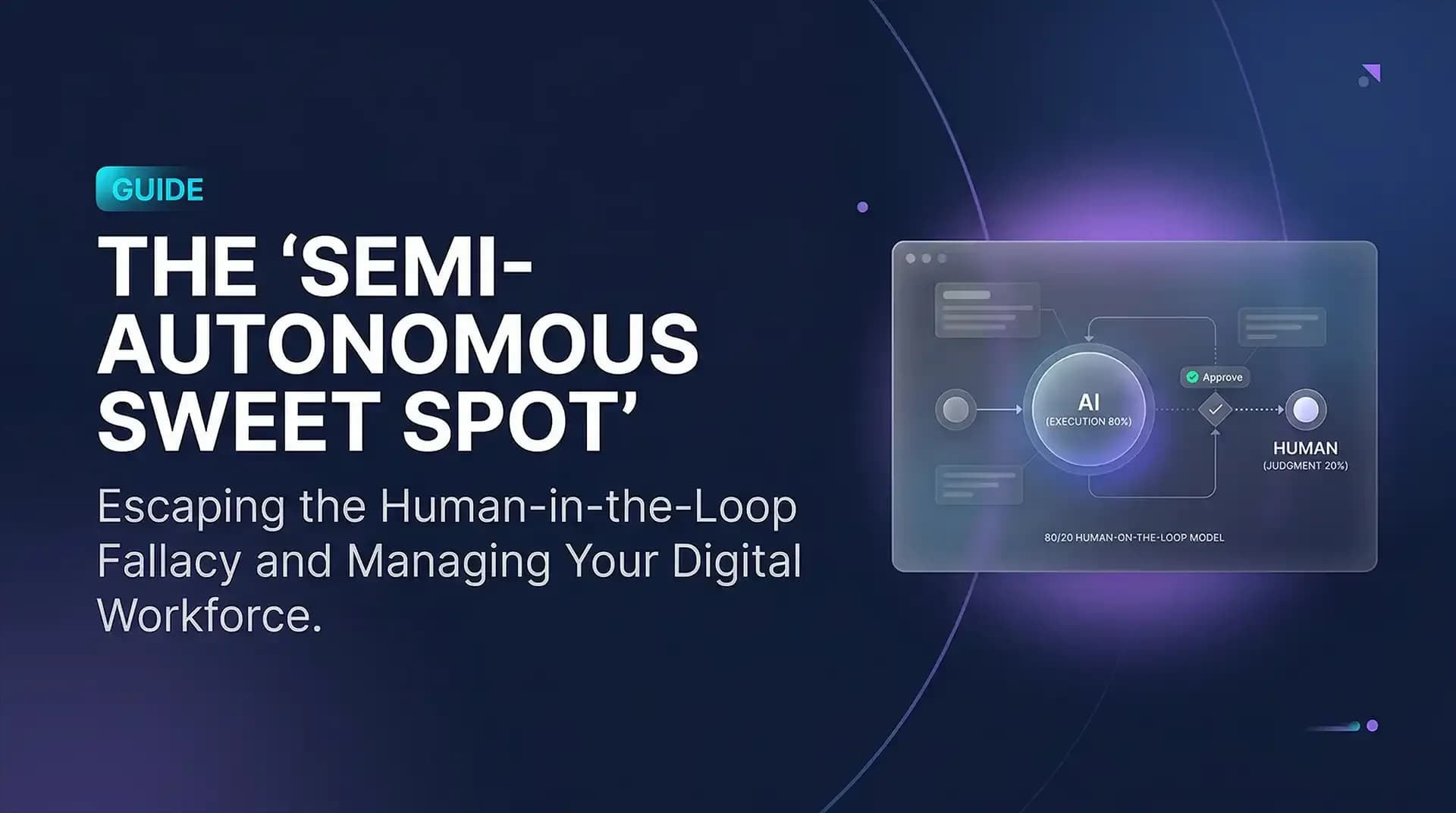
The secret to scaling isn't being \'In-the-Loop,'\ it's being\'On-the-Loop.'\This is theAI human oversightmodel that has become the industry standard for high-growth startups.
In a semi-autonomous workflow, the AI handles 80%'—the repetitive execution, data gathering, and drafting. The human handles the final 20%'—the strategic alignment, the final polish, and the accountability. This \'80/20\ split is the real sweet spot. It gives you the scale of a machine and the \'human touch\ that keeps your content from becoming slop.
Managing Your Digital Workforce: The New Leadership Skill
By 2026,managing AI agentshas become the most important leadership skill in the workforce. You are no longer managing people to do tasks; you are managing a digital workforce to achieve outcomes. This requires a new playbook:
- Setting Clear Goals:Moving beyond simple prompts to logical, intent-driven objectives.
- Defining Reasoning Paths:Providing the \'guardrails\ and logic that an AI must follow to avoid hallucination.
- Active Feedback Loops:Treating your agents like employees—giving them clinical feedback so they can \'learn\ and improve their future outputs.
Building a \'Trust-First\ AI Architecture
The besthuman-AI collaborationhappens when the AI knows when to stop. Modern software architecture is moving away from \'Blind Autonomy\ and toward \'Conditional Autonomy.'\
We now build systems with \'Confidence Thresholds.'\ If the AI is 99% sure of a result, it executes autonomously. If it is only 70% sure, it pauses and pulls the human in for a \'Sovereign Decision.'\ This allows you to stay \'On-the-Loop\ while focusing your limited human energy only on the decisions that truly matter.
Conclusion / CTA
Autonomy is for tasks; Judgment is for humans. In a world where everyone has access to the same models, your advantage lies in your ability to orchestrate them into a cohesive, high-performance team.
Ready to stop chasing the ghost of 100% autonomy?Download our\'AI Orchestrator Playbook\at Zero To AI and learn the frameworks that top founders are using to manage their digital workforce with absolute confidence.
FAQ (People Also Ask)
- What is the difference between In-the-loop and On-the-loop?\'In-the-loop\ implies active participation in every step, while \'On-the-loop\ implies a supervisory role where a human only intervenes at critical checkpoints.
- Why is 100% AI autonomy risky?Because without human judgment, AI can hallucinate, ignore brand-specific context, or create generic content that fails to engage real people.
- How can I build a semi-autonomous system?By identifying the critical steps in your workflow that require a \'decision\ vs. an \'execution\ and placing a human approving gate at those decision points.
Learn to build AI workflows that handle your busywork — live sessions, real projects, zero code.
See the courseBeginner-friendly