.jpg&w=1080&q=75)
No-Code Agent Building: How Plain English is Replacing API Code

Natural Language Workflow Automation: How Plain English is Replacing API Code
You don't need a developer to automate your business anymore.
That sentence would have sounded absurd five years ago. Today, it's a commercial reality. A new wave of low-code and natural-language interfaces is letting business operators describe complex automations the same way they'd explain a task to a new hire — and the system builds the production workflow for them.
This isn't just a UX upgrade. It's a fundamental shift in who gets to build, own, and govern AI-powered processes. And if you're a SaaS founder, solopreneur, or operator trying to move fast without a dedicated engineering team, this shift is the one you've been waiting for.
From API Keys to Plain English: What Changed?
For the last decade, workflow automation meant one of two things: clicking through a rigid Zapier template or hiring a developer to wire up APIs. Neither option scaled well for fast-moving businesses.
The bottleneck wasn't ambition — it was translation. A business owner would have a clear mental model of what they needed ("escalate premium customer complaints within 15 minutes") but no way to express it in code or a pre-built block. An engineer would have the technical skills but lack the domain context to design the logic correctly on the first pass.
Natural language workflow automation closes that translation gap entirely.
Modern platforms can now parse a plain English instruction like:
"If a premium customer submits a complaint, escalate to senior support within 15 minutes and send the customer a proactive apology email."
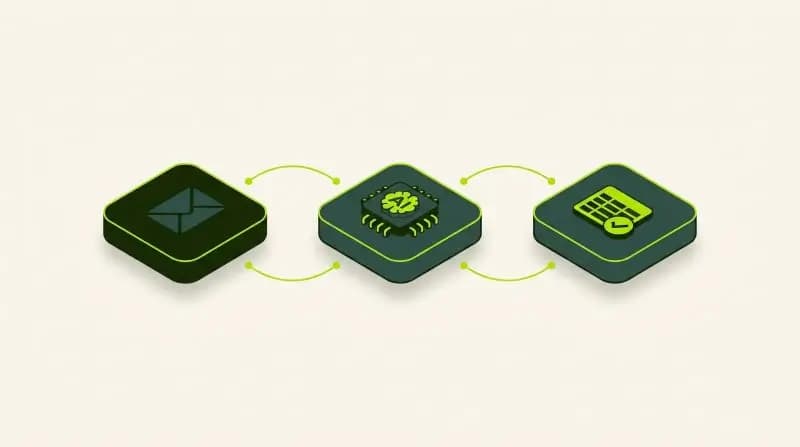
…and generate a working, production-ready automation graph from it. No JSON. No API configuration. No Zapier trigger-action archaeology.
Why 2026 Is the Inflection Point
The LLM capability curve has finally crossed the threshold needed to reliably interpret intent, not just syntax. Models fine-tuned on automation schema — combined with better tool-use, structured outputs, and retrieval from connected data sources — can now generate agentic workflows that are genuinely deployable, not just illustrative.
The Platforms Enabling the Shift
Several platforms are leading this charge, each with a distinct approach:
• n8n has introduced AI node generation — describe what you want a node to do, and it scaffolds the configuration. Its self-hostable architecture makes it a favourite among developers who want control without starting from scratch.
• Zapier AI brings natural language input to the largest no-code automation user base in the world. Its "describe your Zap" feature dramatically lowers the floor for first-time automators.
• Flowise takes a visual, drag-and-drop approach to building LLM-powered agentic chains. Its node-based UI lets non-technical users compose multi-step AI workflows without writing a single line of code.
• Make (formerly Integromat) is building AI-assisted scenario generation, letting users describe business outcomes and receive a suggested automation blueprint.
Each platform excels at accessibility. The open question — and the critical one for enterprise and growth-stage operators — is governance.
Accessibility Is Table Stakes. Governance Is the Differentiator.
Spinning up a workflow from a text prompt is impressive. Ensuring that workflow behaves correctly when edge cases hit, complies with your data policies, and has a human checkpoint before a high-stakes action fires? That's where most no-code platforms still fall short.
IT's New Role: From Builder to Governor
The rise of natural language workflow automation doesn't eliminate IT. It radically changes its job description.
When any operator can generate a workflow with a sentence, the scarcest resource is no longer build capacity — it's governance capacity. IT teams are transitioning from being the people who build the plumbing to being the people who define the rules of the plumbing system.
This means:
• Setting guardrails — defining which data sources agents can access, which actions require approval, and which conditions trigger a human review.
• Auditing AI-generated logic — reviewing workflows created by non-technical users before they touch production systems.
• Owning the taxonomy — establishing shared definitions for business entities (what counts as a "premium customer"? what constitutes a "complaint"?) so that natural language instructions resolve consistently.
• Managing model risk — understanding how the underlying LLM interprets ambiguous instructions and putting correction loops in place.
The organisations that get this right will have a genuine competitive moat. The ones that treat "anyone can build" as a free pass on oversight will accumulate automation debt faster than technical debt.
What This Means for Solopreneurs and Small Teams
If you're a solo founder or a small team, the builder-to-governor shift works in your favour. You are the IT department. You can move fast and set your own guardrails — as long as you're deliberate about it.
The risk isn't that you'll build too slowly. The risk is that you'll build too quickly, and a runaway automation will email 2,000 customers the wrong message at 2am.
The Zero To AI Approach: Accessibility With Human-in-the-Loop Governance
At Zero To AI, we believe accessibility and governance aren't in tension — they're both necessary conditions for automation that actually works at scale.
Our platform is built around Human-in-the-Loop (HITL) orchestration: the principle that AI agents should be able to pause, surface a decision to a human, collect approval or correction, and then continue — without breaking the automation flow.
Here's how that looks in practice with natural language workflow automation:
1. You describe the workflow in plain English. No schema knowledge required. Tell the system what you want to happen, and under what conditions.
2. The system generates the automation graph and highlights checkpoints. Rather than silently executing every step, Zero To AI surfaces moments where human judgment adds the most value — a contract value above a threshold, a refund request outside normal policy, a customer segment that requires a personalised response.
3. You approve, redirect, or override. The agent waits. You make the call. The workflow continues with your input baked in.
4. The system learns from your decisions. Over time, patterns in your overrides and approvals inform smarter default behaviour — so the human-in-the-loop becomes less frequent where confidence is high, and more prominent where it matters most.
This is the Zero To AI model: let plain English build the workflow, let humans own the exceptions.
Practical Examples: Plain English Automations in the Wild
Here are the kinds of workflows that business operators are now building with natural language interfaces — no developer required:
• Customer support escalation: "If a support ticket from a paying customer has been open for more than 2 hours without a response, assign it to the senior support queue and send the customer an update."
• Sales pipeline nudge: "When a deal in our CRM has had no activity for 7 days, send the assigned rep a Slack reminder with the deal's last note attached."
• Content repurposing: "Every time we publish a new blog post, extract the key insights, draft three LinkedIn post variations, and add them to our content calendar for review."
• Subscription churn signal: "If a user's session frequency drops more than 50% week-over-week, flag them in our CRM as churn risk and trigger a personalised check-in email sequence."
• Invoice anomaly review: "Before any invoice above £10,000 is sent, pause and notify the founder for approval."
Notice the last one. That's HITL in a single sentence.
Learn to build AI workflows that handle your busywork — live sessions, real projects, zero code.
See the courseBeginner-friendly