.jpg&w=1080&q=75)
OpenAI's First AI Hardware Device: What Sam Altman & Jony Ive's Screenless Gadget Means for Business

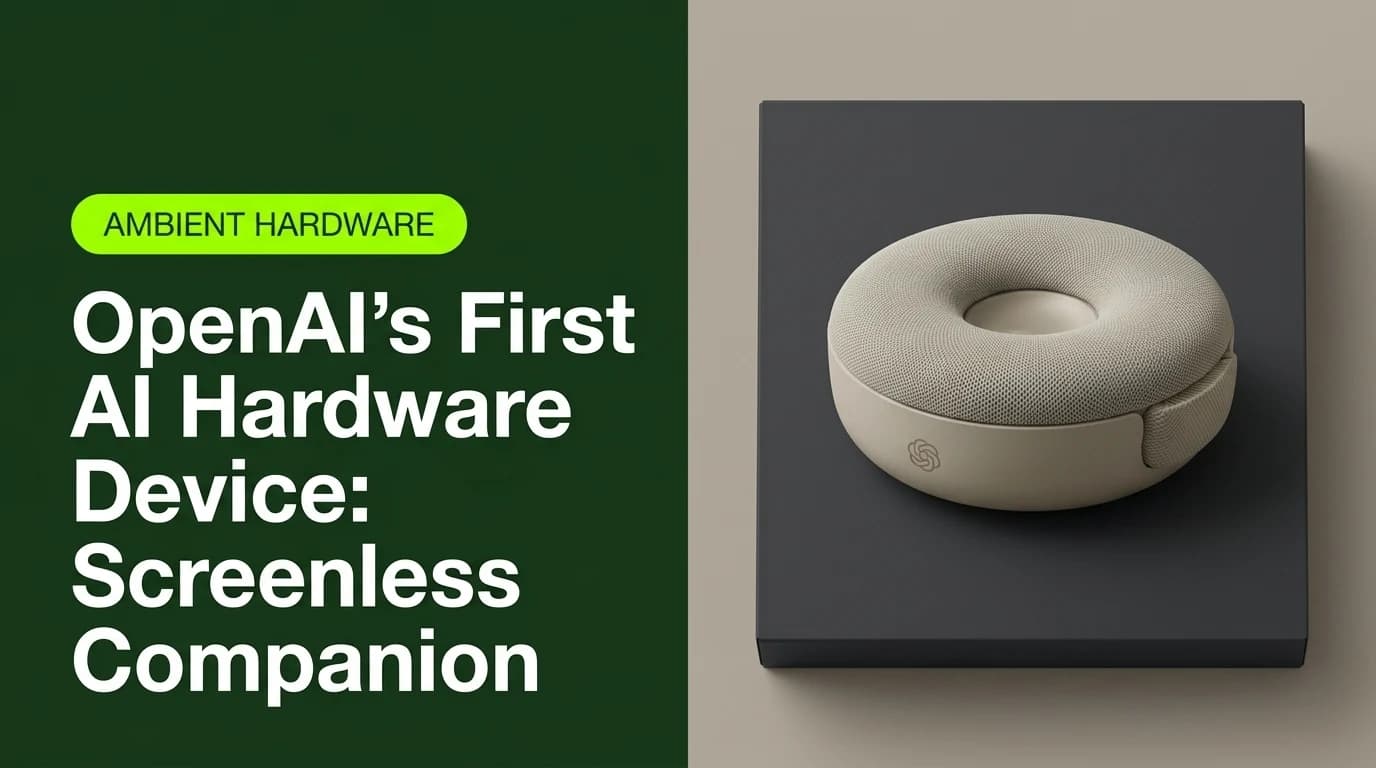
OpenAI’s first AI hardware device, developed with former Apple design chief Jony Ive, is a screenless, portable ambient computer priced between $300 and $400 designed for continuous voice and environmental AI automation.
As generative AI software matures, tech industry focus is shifting from mobile applications toward dedicated physical hardware. While smartphones require users to unlock screens, navigate apps, and type prompts manually, OpenAI is developing a new class of ambient consumer electronics. Led by OpenAI CEO Sam Altman and former Apple Chief Design Officer Jony Ive (following OpenAI's acquisition of Ive's startup io), this flagship hardware initiative aims to replace traditional screen interfaces with seamless conversational interactions.
Understanding the design philosophy, physical control mechanics, technical architecture, and expected market release allows non-technical business owners and professionals to prepare for screenless workplace automation.
Key Facts: OpenAI AI Hardware Device Specifications & Status
The following matrix summarizes confirmed hardware specifications surrounding OpenAI's first physical device:
Hardware Attribute | Confirmed Specification / Infographic Details | Business Utility & Non-Coder Impact |
|---|---|---|
Lead Designers & Executives | Sam Altman (OpenAI) & Jony Ive (LoveFrom / io) | Combines world-class industrial design with advanced LLM reasoning |
Form Factor & Design | Screenless, portable, fabric doughnut/puck shape | Hands-free ambient operation without screen distractions |
Physical Tactile Controls | Spin (Volume), Tilt (Mute Mic), Click (Custom Shortcut) | Intuitive physical feedback without looking at a display |
Target Retail Price | $300 to $400 USD (~25,000 INR to 33,000 INR) | Accessible entry cost for small business owners & solopreneurs |
Expected Commercial Release | Preview phase starting 2026 / Launch 2027 | Allows businesses to transition toward ambient AI workflows early |
Software Integration | Native ChatGPT voice, agentic API triggers | Operates as a physical digital assistant executing task pipelines |
Tactile Physical Mechanics: Spin, Tilt, and Click
Unlike traditional screen interfaces, OpenAI's doughnut-shaped puck device incorporates intuitive tactile moving parts designed to give the hardware physical responsiveness:
[Spin: Rotate to Adjust Volume] ──> [Tilt: Tilt to Mute Microphone] ──> [Click: Activate Custom Shortcut]1. Spin (Volume Adjustment)
Users rotate the tactile fabric outer ring to adjust ambient audio output smoothly during voice interactions or meeting playback.
2. Tilt (Hardware Mute Toggle)
Tilting the puck device physically disconnects or mutes the internal microphone array, providing instant privacy control for sensitive client discussions.
3. Click (Custom Shortcut Trigger)
Pressing the side dial button triggers custom pre-configured workflow shortcuts—such as sending a meeting transcript to Notion or starting a voice dictate session.
Design Philosophy: From Smartphone Screens to Ambient AI
For nearly two decades, mobile computing has relied on glass touchscreens that demand total visual focus. The OpenAI and Jony Ive collaboration represents a fundamental shift toward screenless computing:
[Smartphone Era: Unlock -> Open App -> Type Prompt -> Read Output]
↓
[Ambient AI Era: Speak Natural Intent -> Sensors Capture Context -> Agent Executes Workflow]
1. Eliminating Visual Friction
Instead of opening multiple applications to complete a single task, the device acts as a continuous listener. Users state their objective, and the underlying AI reasoning engine determines which background software actions to take.
2. Contextual Environmental Sensing
Equipped with spatial cameras and multi-directional microphones, the device understands user surroundings—allowing it to analyze physical documents, identify objects, and summarize meeting conversations in real time.
3. Screenless Multitasking for Professionals
Business operators can query inventory, draft customer replies, or update CRM records while driving, reviewing physical inventory, or managing retail store floors.
4 Business Workflow Transformations for Non-Coders
The introduction of dedicated screenless AI hardware will transform daily business operations across four key areas:
- Hands-Free Retail & Warehouse Management: Store managers can audit physical shelf stock by voice, allowing the device camera to calculate inventory counts and update databases automatically.
- Real-Time Meeting Summarization: Placing the device on a conference table allows it to transcribe multi-person discussions, extract action items, and dispatch task assignments to Slack or Notion.
- Ambient Customer Support Assistance: Service professionals can consult the AI device via earbud or speaker during live customer calls to fetch product details without switching computer tabs.
- Voice-Driven Content & Email Drafting: Solopreneurs can dictate complex client proposals or marketing briefs during commutes, allowing background agents to format and queue drafts instantly.
Relevant Web Image Resources & References
For visual reference on ambient hardware concepts, smart speaker designs, and AI device interfaces, consult the following public image resources:
- OpenAI Official Branding & News Assets: https://images.unsplash.com/photo-1677442136019-21780efad99a (Unsplash AI Technology Concept)
- Minimalist Hardware Design Concept: https://images.unsplash.com/photo-1546435770-a3e426bf472b (Unsplash Minimalist Consumer Electronics)
- Smart Voice Companion Interfaces: https://images.unsplash.com/photo-1589254065909-b7086229d08c (Unsplash Smart Assistant Hardware)
- Ambient Desktop Workspaces: https://images.unsplash.com/photo-1498050108023-c5249f4df085 (Unsplash Modern Tech Workspace)
Learn to build AI workflows that handle your busywork — live sessions, real projects, zero code.
See the courseBeginner-friendly