
How Indian Small Businesses Can Use Perplexity AI for Competitor Research (Without Expensive Subscriptions)
How Indian Small Businesses Can Use Perplexity AI for Competitor Research (Without Expensive Subscriptions)
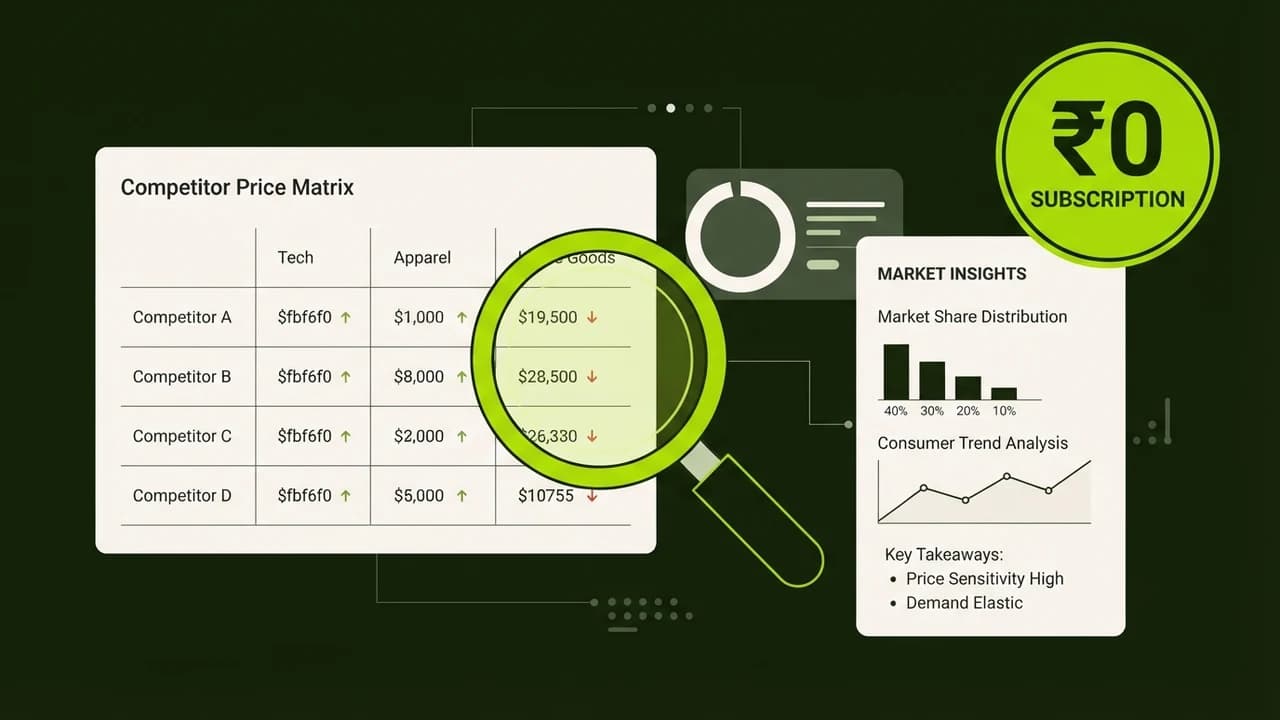
Indian small businesses can uncover competitor pricing strategies, supplier networks, and customer pain points in under fifteen minutes using Perplexity AI free search queries without paying for enterprise research tools like SEMrush or Nielsen. By querying real-time web citations instead of static keyword lists, Indian entrepreneurs gain immediate market intelligence.
Traditional competitor research in India has historically been both expensive and slow. Enterprise market intelligence platforms charge upwards of ₹15,000 to ₹35,000 per month. This cost puts deep competitive analysis far out of reach for local retail brands, bootstrapped D2C founders, regional wholesale distributors, and digital service agencies.
Most business owners end up manually browsing twenty different competitor websites, guessing profit margins, or relying on outdated word-of-mouth gossip.
Perplexity AI alters this dynamic completely. Because Perplexity functions as an Answer Engine that searches live web indices and cites verified sources, you can ask granular, conversational questions about your specific market and receive synthesized, citation-backed intelligence instantly.
Traditional Market Research vs Perplexity AI Research
Evaluation Criteria | Traditional Research Tools (SEMrush / Ahrefs / Agency) | Free Perplexity AI Intelligence Workflow |
|---|---|---|
Monthly Cost | ₹12,000 to ₹35,000 per seat license | ₹0 (Free tier) to ₹1,650/month (Pro) |
Data Recency | 30 to 90-day crawl delay on smaller Indian sites | Live web indexing within hours |
Output Format | Complex tabular spreadsheets and keyword difficulty charts | Direct narrative answers with source URLs and comparison tables |
Local Market Nuance | Weak indexing of Tier 2/3 regional Indian markets | Extracts data from IndiaMART, Justdial, Reddit India, and regional news |
Time to First Insight | 4 to 8 hours of manual data sorting | 90 seconds per prompt query |
4 High-Impact Competitive Workflows for Indian Business Owners
Workflow 1: Reverse-Engineering Competitor Pricing and Margin Structures
Pricing is the single most guarded secret among Indian regional distributors and service companies. However, competitor pricing is frequently leaked in customer reviews, IndiaMART listings, and local forum discussions.
The Prompt Strategy:
"Analyze the retail pricing structure of [Competitor Name] in India across their core product line. Compare their listed MRP against their actual discounted checkout price on Amazon India, Flipkart, and their direct website. Identify what volume discounts or bundled packages they offer to wholesale buyers."
Perplexity crawls active marketplace listings and presents a side-by-side table showing MRP, effective selling price, and active promotional coupons within 30 seconds.
Workflow 2: Uncovering Competitor Supplier and Logistics Networks
If a competitor is undercutting you on delivery speed or unit manufacturing cost, their supply chain holds the answer.
The Prompt Strategy:
"What third-party logistics providers (3PL) and manufacturing hubs does [Competitor Brand] partner with in India? Search their shipping policy page, import-export customs records, packaging trade marks, and founder podcast interviews."
This query surfaces details such as their primary warehouse hub (e.g., Bhiwandi or Gurugram) and their fulfillment partners (e.g., Shiprocket, Delhivery, or Bluedart).
Workflow 3: Mining Competitor One-Star Reviews for Product Flaws
Your competitor's dissatisfied customer is your most qualified sales prospect. When customers leave negative reviews on Google Maps, Amazon, or Trustpilot, they state exactly what they wish the competitor did differently.
The Prompt Strategy:
"Summarize the top 5 recurring complaints in 1-star and 2-star customer reviews for [Competitor Product/Service] on Amazon India and Google Reviews over the past 6 months. Group these complaints into: Product Durability, Delivery Delays, Customer Support Responsiveness, and Hidden Charges."
Use the resulting summary to adjust your own marketing copy, highlighting how your product eliminates those specific failure points.
Workflow 4: Tracking Regional Expansion and Hiring Signals
When a competitor begins recruiting heavily for specific roles in cities like Pune, Ahmedabad, or Hyderabad, it signals their next market expansion.
The Prompt Strategy:
"What open job listings has [Competitor Name] posted on LinkedIn India and Naukri over the last 90 days? Analyze the job titles and locations to predict which geographic markets or product categories they are launching next."
Step-by-Step Implementation Guide for Local Business Owners
- Step 1: Set Up Your Free Perplexity Workspace: Create an account at perplexity.ai. Ensure your search focus is set to 'All' or 'Web' to capture broad live citations.
- Step 2: Build a Competitor Tracking Matrix: Open a blank Google Sheet with four columns: Competitor Name, Pricing Structure, Top Customer Pain Point, and Supply Chain Advantage.
- Step 3: Run the 4 Core Diagnostic Prompts: Execute each diagnostic prompt outlined above for your top three direct competitors.
- Step 4: Verify Live Citations: Click through the superscript citation numbers in Perplexity to cross-check claims against original source documents.
- Step 5: Implement 1 Tactical Differentiator: Within 24 hours of gathering intelligence, update your landing page hero banner, WhatsApp sales script, or quotation template to counter your competitor's primary documented weakness.

Learn to build AI workflows that handle your busywork — live sessions, real projects, zero code.
See the courseBeginner-friendly