.jpg&w=1080&q=75)
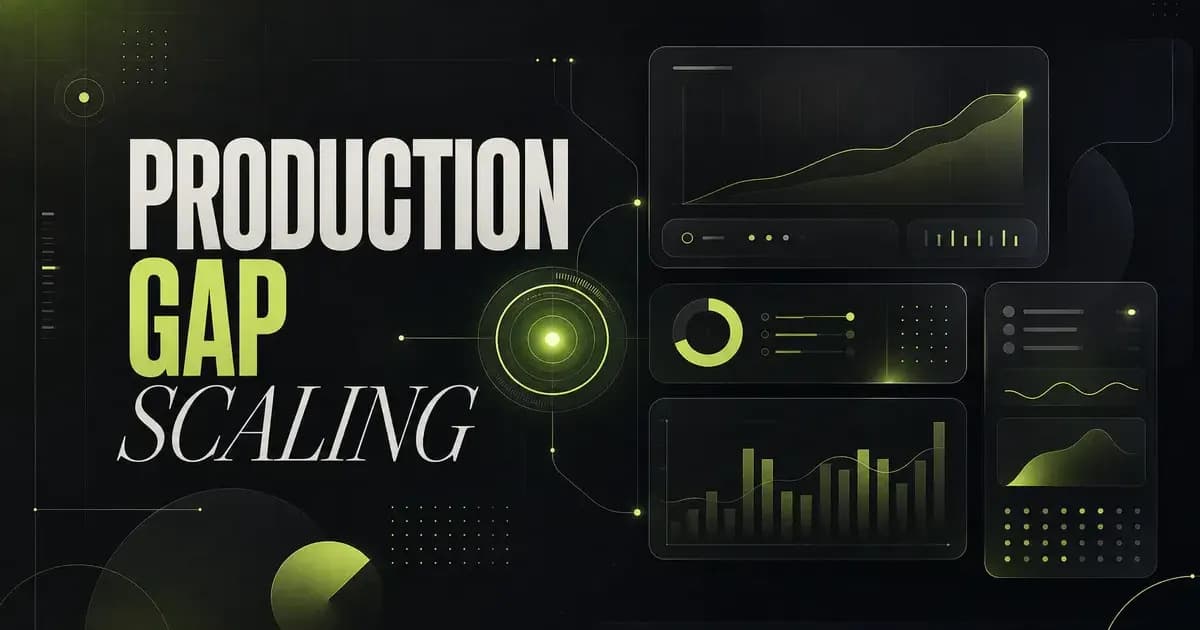
The 2026 "Production Gap": Why 77% of AI Agent Pilots Fail to Scale

The 2026 "Production Gap": Why 77% of AI Agent Pilots Fail to Scale
We are officially living in the era of the autonomous agent. If you scroll through your feed, you’ll see dozens of demonstrations: agents writing full-stack code, agents automating entire marketing campaigns, and agents routing support tickets. Startups and enterprise teams alike are spinning up pilot programs at a record pace.
Yet, a silent crisis has emerged in the tech industry: The 2026 Production Gap.
Recent industry data reveals a sobering statistic: while nearly 90% of organizations are actively experimenting with AI agents, 77% of those pilot programs fail to scale into production. They remain locked in local environments, running as toy projects that never deliver actual business value.
At zerotoai, we teach the difference between a prototype that works once on a local machine and an agentic system that runs reliably in production. This article analyzes the root causes of the production gap and outlines the technical roadmap to bridge it.
Why Pilot Programs Fail: The 3 Operational Hurdles
Building an agent that works on a single clean input is easy. Building a system that handles 10,000 real-world inputs without breaking is incredibly difficult.
When organizations try to scale their agents, they hit three major operational hurdles:
1. The Cost and Token Wall
In a pilot environment, developers don’t notice when an agent makes ten LLM calls to solve a single problem. But in production, running hundreds of multi-step loops a day quickly leads to compounding API bills. Without token limits and cost guardrails, autonomous systems become financial liabilities.
2. The Runaway Loop Problem
When given full autonomy over a tool-use loop, a probabilistic model will eventually get stuck. It will repeat the same query, misinterpret an API error, or hallucinate a database key, leading to endless execution cycles. In production, a runaway loop doesn't just waste tokens—it can freeze your system and lock database resources.
3. The "Black Box" Governance Deficit
If an agent acts autonomously, it must be auditable. When a customer receives an incorrect refund or a marketing campaign goes live with typos, the operations team needs to trace the exact decision path the agent took. Without structured logging and trace observability, IT departments refuse to authorize production deployments.
How to Bridge the Gap: The Production Roadmap
To transition your agents from local scripts to production systems, your engineering team must move past raw prompt-engineering and focus on Harness Engineering.
Here is the 3-step blueprint we teach at the Zero To AI University:
Step 1: Force Schema Compliance
Never let your agent output raw markdown or unstructured JSON. Use schema validation libraries (like PydanticAI) to force the model to output strictly typed data. If the output fails validation, the harness must automatically catch the error and request a correction before executing any database writes.
Step 2: Implement Hybrid Orchestration
Stop using single, unstructured agent prompts. Break your workflow into a hybrid architecture where traditional, deterministic code handles the routing, database reads, and error catching, while the LLM is reserved strictly for reasoning nodes. This reduces hallucination rates by up to 90%.
Step 3: Insert Human-in-the-Loop Gates
The scariest part of scaling is loss of control. Bridge the trust gap by setting up secure pause-and-resume gates. Let the agent do the initial research and draft the payload, but send a Slack notification or web button for a human operator to click APPROVE before any public-facing or financial action is finalized.
Conclusion: Scale Requires Systemic Thinking
The competitive advantage in 2026 isn't knowing how to write a clever system prompt. The advantage belongs to the builder who understands how to wrap a probabilistic model in a deterministic software harness.
Stop building isolated chatbots. Start building secure, scalable systems of action that integrate seamlessly with your core databases.
Ready to move your agents from local scripts to production?
[Enroll in our Zero To AI Production Accelerator] and get access to our pre-built n8n and LangGraph governance templates.
Learn to build AI workflows that handle your busywork — live sessions, real projects, zero code.
See the courseBeginner-friendly