.jpg&w=1080&q=75)
The Shadow Prompt Technique: Getting Better Responses Without Typing More

We’ve officially declared that traditional prompt engineering is dead. You no longer need to spend 20 minutes crafting an overly complex paragraph begging an LLM to act like a confident 25-year-old marketing executive who speaks English as a first language.
In 2026, the real leverage happens beneath the surface. If you want consistently brilliant outputs without typing massive prompts every single time, you need to master the Shadow Prompt.
Here is how advanced prompting techniques 2026 operate on a systems level.
What is a Shadow Prompt?
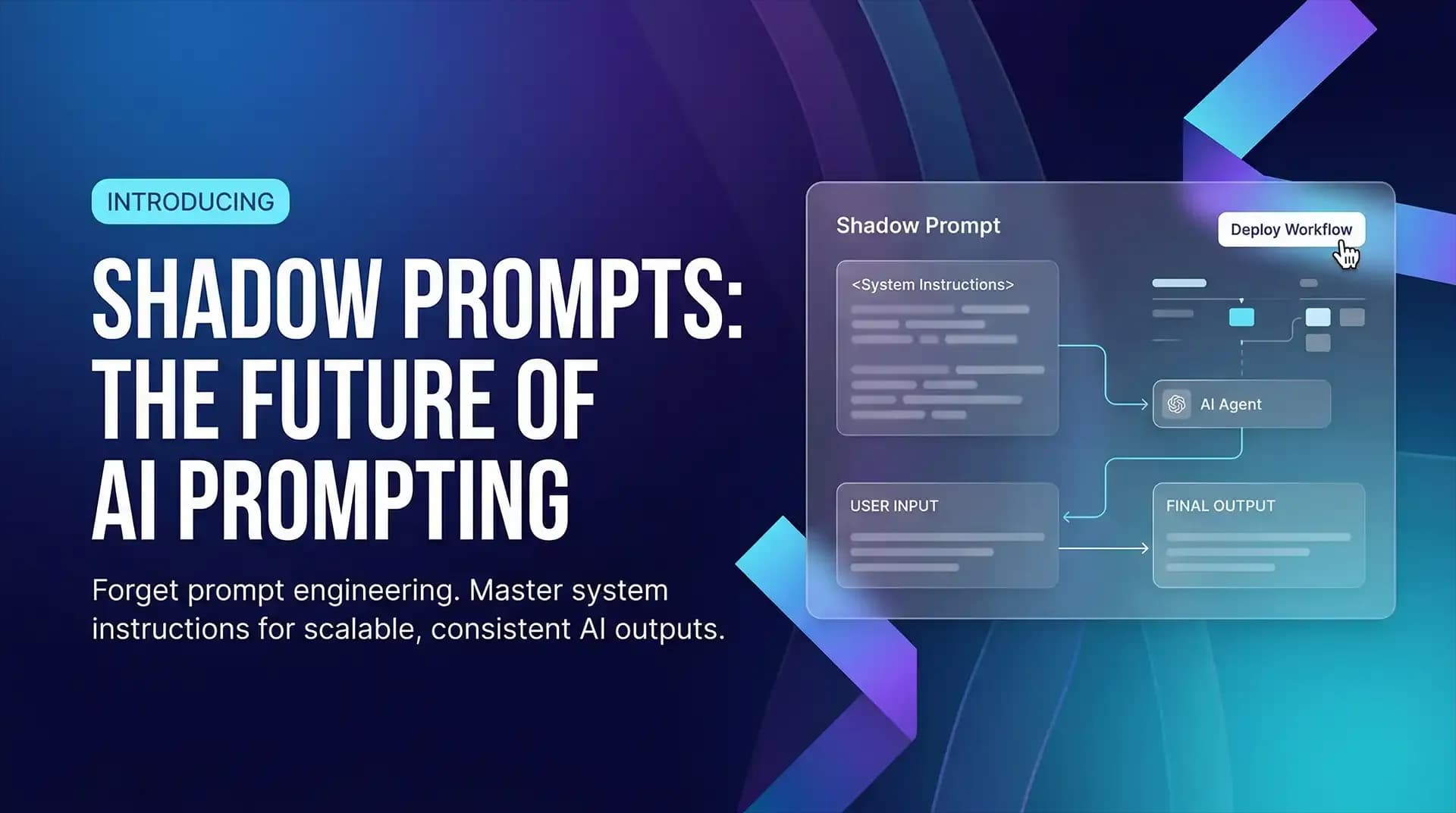
A Shadow Prompt (often referred to technically as a System Instruction or Meta-Prompt) is an invisible set of behavioral guardrails that govern your AI agent before the user ever types a single word.
When you build a workflow in n8n, you dont expose the raw LLM to the end-user. Instead, you build a wrapper. The user types something simple like, Write a post about productivity. The users input is then injected into a massive, meticulously structured Shadow Prompt that lives hidden inside your n8n node.
System Level Instructions AI
The shadow prompt dictates the core persona, the strict formatting rules, the brand voice, and the negative constraints (what the AI mustneversay).
For example, a strong Shadow Prompt looks like this:
<System>
You are the brand voice of Zero to AI. You are encouraging, highly technical but accessible, and anti-hustle culture.
Rule 1: Never use the words In todays digital landscape.
Rule 2: Always format your output in markdown.
Rule 3: User input follows below. Apply these rules flawlessly.
<'/System>
Because these instructions reside at the system level, the user experiences magic. The prompt engineering future is entirely about the developer building these robust hidden frameworks, allowing the end-user to be completely lazy.
Consistency at Scale
The primary benefit of the shadow prompt technique is absolute consistency. If you are automating a massive content pipeline to generate 300 blog posts, you cannot rely on manual prompt adjustments. The shadow prompt ensures that output #1 and output #300 maintain the exact same tone, style, and formatting structure.
Conclusion: Hide the Complexity
The goal of a great AI Orchestrator is to absorb the complexity so the end-user doesnt have to. Mastering system instructions is the key to building agents that feel reliable, branded, and incredibly intelligent.
Want to learn how to inject powerful system prompts into your n8n workflows?Join the Zero to AI 90-Day Reskilling Workshopand master the art of the Shadow Prompt.
Learn to build AI workflows that handle your busywork — live sessions, real projects, zero code.
See the courseBeginner-friendly