.jpg&w=1080&q=75)
Trusted Autonomy: How to Design AI Workflows Your Team Actually Trusts

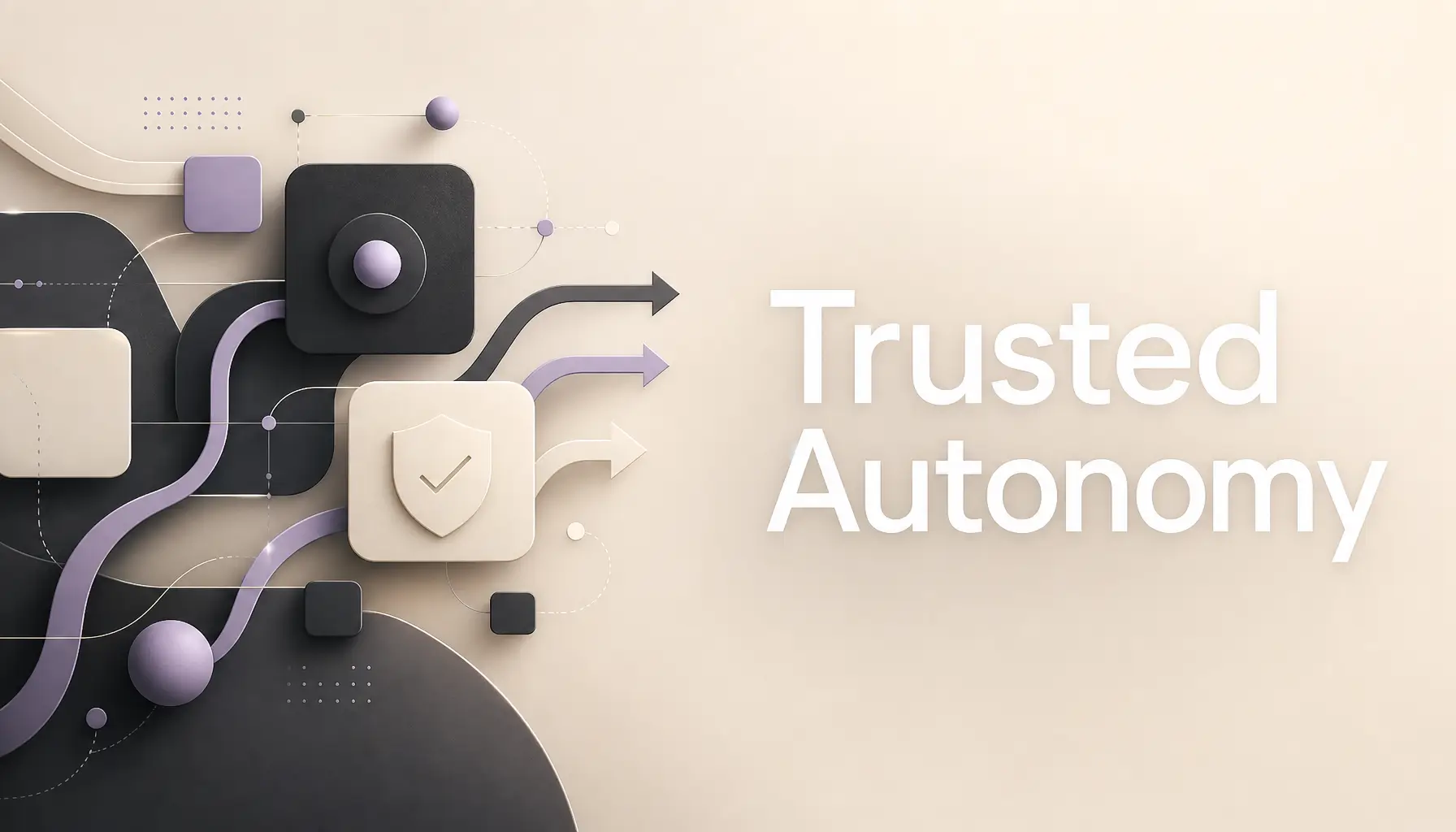
Trusted AI Autonomy Workflow Design: How to Build AI Agents Your Team Actually Trusts
There's a number that should stop every AI-forward leader in their tracks.
Recent surveys across enterprise and mid-market organisations consistently show that a significant majority of employees — often north of 60% — prefer AI agents to have no independent action abilities whatsoever. They want a human in control at every meaningful decision point. Not because they don't understand the technology. But because they don't trust it yet.
That's the trust deficit. And if you're building AI workflows without addressing it head-on, you're not automating your business — you're quietly accumulating organisational debt that will eventually surface as resistance, workarounds, and outright rejection.
The good news? Trusted AI autonomy workflow design is a solvable problem. And in this post, we're going to walk you through exactly how to solve it.
Why the AI Trust Deficit Exists (And Why It's Rational)
Before you can fix mistrust, you need to respect why it exists. Your team's skepticism isn't irrational — it's earned.
Hallucinations Are Real and Costly
Large language models confabulate. They produce confident, well-structured, completely incorrect outputs with alarming frequency. When an AI agent acts on a hallucinated result — sending the wrong price to a customer, deleting the wrong records, or firing off a compliance-adjacent email — there's no one to catch it. That's terrifying, and it should be.
Irreversible Actions Have No "Undo"
Human mistakes are usually recoverable. An AI agent operating at machine speed and scale can cause damage that takes days to reverse — or can't be reversed at all. A bulk data delete, a mass email send, a payment trigger: all of these are catastrophic if wrong, and most AI systems don't natively build in rollback paths.
Black-Box Decisions Breed Suspicion
When your team can't see why an agent made a decision, they can't trust it. "The AI said so" is not an acceptable audit trail. Without explainability, every autonomous action is a leap of faith — and most professionals aren't paid to take those leaps on behalf of their organisation.
The 4 Design Principles of Trusted AI Autonomy
Building trust isn't about restricting AI — it's about designing it thoughtfully. Here are the four principles that form the backbone of every trusted AI autonomy workflow design.
Principle 1: Explainability — Agents Must Show Their Work
An AI agent should never just output a result. It should log its reasoning in plain, human-readable language at every step.
Think of it like a junior analyst submitting a recommendation: they don't just hand you a number, they walk you through the data sources, the assumptions they made, and the logic they followed. Your agents should do the same.
What explainability looks like in practice:
• Reasoning logs attached to every action, written in plain language (not raw JSON or token dumps)
• Confidence scores surfaced alongside outputs, so reviewers know when to scrutinise more closely
• Source attribution — which data, which documents, which API responses influenced this decision
• Decision summaries that a non-technical stakeholder can read in under 30 seconds
When your team can see the reasoning, they can spot errors, correct the agent, and gradually build confidence. Explainability transforms AI from a black box into a transparent collaborator.
Principle 2: Reversibility — Every Write Action Needs an Undo Path
Here's a simple rule: if an action can't be undone, a human must approve it before it runs.
In practice, this means designing your AI workflows with staging layers and rollback mechanisms baked in from day one — not bolted on after the first incident.
Reversibility patterns that actually work:
• Staging queues — write actions go to a review buffer before executing against production
• Soft deletes — records are flagged for deletion and held for a configurable period before permanent removal
• Draft states — emails, messages, and documents are created as drafts, not sent
• Transaction previews — financial moves display a full summary and require explicit confirmation
• Audit snapshots — the system captures the state before any write, enabling point-in-time restoration
Reversibility is what separates an AI workflow your team tolerates from one they embrace. When people know mistakes can be caught and corrected, anxiety drops dramatically.
Principle 3: Human-in-the-Loop Approval Gates — The Non-Negotiables
Not every task needs a human checkpoint. Pulling a report? Fine. Summarising a document? Go ahead. But there are categories of action where human approval is non-negotiable, and your workflow architecture needs to enforce this structurally — not just as a policy.
The HITL gate triggers — always require human approval when:
• 💸 Money moves — any payment, refund, invoice, or financial transfer above a defined threshold
• 🗑️ Data is deleted — especially bulk operations or anything touching customer PII
• 📤 Messages send externally — emails to customers, partners, or regulators; social media posts; compliance communications
• 🔑 Permissions change — access grants, role modifications, API key generation
• ⚙️ Configuration updates — environment variables, feature flags, billing plan changes
The key is making these gates structural, not advisory. The agent cannot proceed without a human approval token. This isn't a suggestion in a README — it's enforced at the workflow engine level.
Zero To AI's HITL framework implements these gates natively, meaning the approval step is a first-class citizen of the workflow, not an afterthought.
Principle 4: Scope Limits — Least-Privilege for AI Agents
Your AI agent should only have access to exactly what it needs to complete its current task. Nothing more.
This is the principle of least-privilege applied to AI — a concept borrowed from security engineering that is critically underused in AI workflow design. When an agent has access to every database, every API endpoint, and every file system path, the blast radius of any mistake (or any adversarial prompt injection) is enormous.
Scope limits in trusted AI autonomy workflow design:
• Task-scoped credentials — temporary, narrowly-scoped API tokens that expire after the task completes
• Read-only by default — agents start with read access; write access must be explicitly granted per task
• Data isolation — agents only see the records relevant to their current job, not the entire database
• Time-bounded access — credentials automatically revoke after a session window closes
• Namespace restrictions — agents operate in sandboxed environments with no lateral movement to adjacent systems
Scope limits are the ultimate safety net. Even if everything else fails — even if the model hallucinates, even if the logic is wrong — a properly scoped agent can only break what it was allowed to touch.
How These 4 Principles Work Together
These principles aren't a checklist — they're a system. Each one reinforces the others.
Explainability makes HITL gates fast (reviewers understand what they're approving). Reversibility makes scope limits less anxious (write access is less scary when rollback exists). HITL gates make explainability accountable (reasoning logs matter when a human is actually reading them). And scope limits make all three safer by shrinking the failure surface.
When you implement all four together, something remarkable happens: your team stops fighting the AI and starts working with it. The agent earns trust incrementally, decision by decision, because every decision is legible, recoverable, supervised, and contained.
Zero To AI's HITL Framework: Trusted Autonomy in Practice
At Zero To AI, we've built our entire platform around the thesis that AI without human oversight isn't autonomy — it's liability.
Our HITL (Human-in-the-Loop) orchestration framework implements all four principles out of the box:
• ✅ Reasoning logs generated at every agent step, surfaced in a plain-language audit trail your whole team can read
• ✅ Staging layers for write actions with configurable review windows and one-click rollback
• ✅ Approval gate engine that structurally enforces human sign-off on money, data, messages, and access changes — no policy documents required
• ✅ Least-privilege credential system with task-scoped, time-bounded access tokens generated on demand
Whether you're orchestrating customer support agents, financial reconciliation bots, or internal operations workflows, Zero To AI gives you the architecture to deploy with confidence — and the oversight tools to keep your team in control every step of the way.
Trusted AI autonomy workflow design isn't a future aspiration. It's available today.
👉 Start building trusted AI workflows at zerotoai.in
Quick Checklist: Is Your AI Workflow Trust-Ready?
Before you deploy your next AI agent, run through this checklist:
• [ ] Does every agent action produce a plain-language reasoning log?
• [ ] Do all write actions pass through a staging layer or require explicit confirmation?
• [ ] Are HITL approval gates structurally enforced (not just documented in a policy)?
• [ ] Do your agents operate on the minimum permissions required for each task?
• [ ] Do credentials expire automatically after task completion?
• [ ] Is there a rollback or undo path for every destructive action?
• [ ] Can a non-technical stakeholder understand any agent decision in under 60 seconds?
If you answered "no" to more than two of these, your AI workflow has a trust gap — and your team already knows it, even if they haven't said so yet.
Learn to build AI workflows that handle your busywork — live sessions, real projects, zero code.
See the courseBeginner-friendly