.jpg&w=1080&q=75)
The Rise of "Vibe Designing": Why AI Can Generate, but Can''t Feel Your Brand

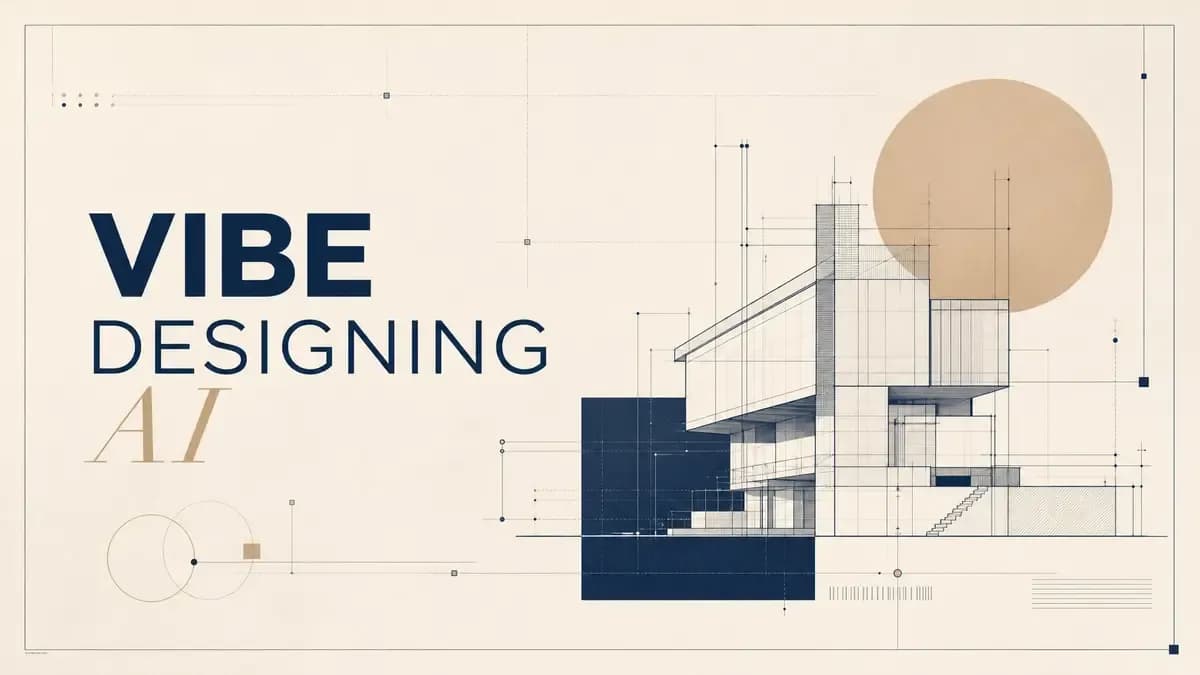
The Rise of "Vibe Designing": Why AI Can Generate, but Can't Feel Your Brand
We’ve all heard of "vibe coding"—the trend where developers use natural language models to spin up fully functional applications without writing a single line of syntax. In 2026, this phenomenon has officially crossed over into the creative department.
Welcome to the era of "Vibe Designing."
Today, anyone with a browser can type a prompt and generate high-fidelity vector illustrations, 3D renders, and complete UI layouts in seconds. The barrier to technical execution has effectively dropped to zero. But as the internet floods with AI-generated visual assets, a critical realization is setting in: AI can generate. It cannot feel.
At zerotoai, we look past the hype of push-button design tools. This article explores the rise of Vibe Designing, why it is disrupting the design community, and how human-in-the-loop curation remains the only true brand moat in an automated world.
What is Vibe Designing?
Vibe Designing is the process of creating visual brand assets and interfaces by using generative AI models to translate high-level stylistic directions ("vibes") into concrete designs.
Instead of opening Figma or Illustrator and manually drawing vector points, a Vibe Designer describes the mood, color system, and layout to an AI assistant:
• "Give me a glassmorphic dashboard UI for an AI-security company, using dark purple and neon teal tones, with a clean sans-serif font."
• "Create a 3D claymation-style character model of an octopus holding a laptop."
Within seconds, the tool produces ten variations. The designer's job changes from crafting the assets to directing and curating the outputs.
The Illusion of Perfection: Why Generative AI Design Falls Flat
On paper, Vibe Designing seems like a miracle. It accelerates ideation and cuts asset production costs by 90%. However, pure AI-generated designs often suffer from a subtle but fatal flaw: they lack Brand Soul.
Why 100% automated design fails:
• The Homogenization Trap: AI models are trained on existing web data. When everyone uses the same tools, the entire internet starts looking like the same generic Dribbble layout.
• The Empathy Gap: AI does not understand human emotion, cultural context, or the subtle tension that makes a great design memorable. It doesn't know why a specific layout evokes trust or excitement.
• Zero Functional Continuity: Generative tools can create a beautiful mockups, but they struggle to maintain strict design system variables, responsive constraints, and accessibility requirements.
Taste is the New Technical Skill
In a world where everyone has a magic button to generate images, the value of the button drops to zero. The only value that remains is your Taste.
As a designer or founder in 2026, your competitive advantage isn't your speed in Figma; it's your ability to act as a Creative Director.
Your value lies in:
1. Curation: Sifting through 100 AI-generated iterations and selecting the single one that aligns with the brand's long-term identity.
2. Synthesis: Combining disparate concepts that an AI would never think to merge because they lie in different training datasets.
3. Human Touch: Injecting intentional irregularities, hand-drawn elements, or custom micro-animations that break the "uncanny" perfection of AI slop.
How to Practice Responsible Vibe Designing
At zerotoai, we recommend a three-step hybrid workflow to leverage AI tools without losing your brand's unique identity:
Phase 1: AI Ideation (Vibe Mapping)
Use generative models to quickly build visual mood boards, test color combinations, and explore wild design directions. This is where you leverage the AI's speed.
Phase 2: Human Synthesis
Take the best elements from the AI generations and manually bring them into Figma or your rendering engine. Rebuild the core structures to fit your design system and grid rules.
Phase 3: The Polish Gate
Ensure all illustrations, icons, and UI assets are cleaned of AI glitches (like weird gradients, irregular curves, or extra limbs). Inject custom micro-animations to bring the interface to life.
Conclusion: The Moat is How It Feels
Vibe Designing is here to stay. It is an incredibly powerful tool that can free creatives from tedious asset production. But do not confuse the tool with the designer.
An AI can generate a thousand layouts, but only a human can feel if a layout is right for a brand's story. Protect your business from visual slop by keeping a human firmly in the loop.
Want to build premium, high-converting brand designs with AI?
[Explore the Zero To AI Design Systems Workshop] and learn how to pair generative tools with professional Figma workflows.
Learn to build AI workflows that handle your busywork — live sessions, real projects, zero code.
See the courseBeginner-friendly