.jpg&w=1080&q=75)
Beyond APIs: How "Computer-Using Agents" (CUAs) Are Automating Legacy Systems

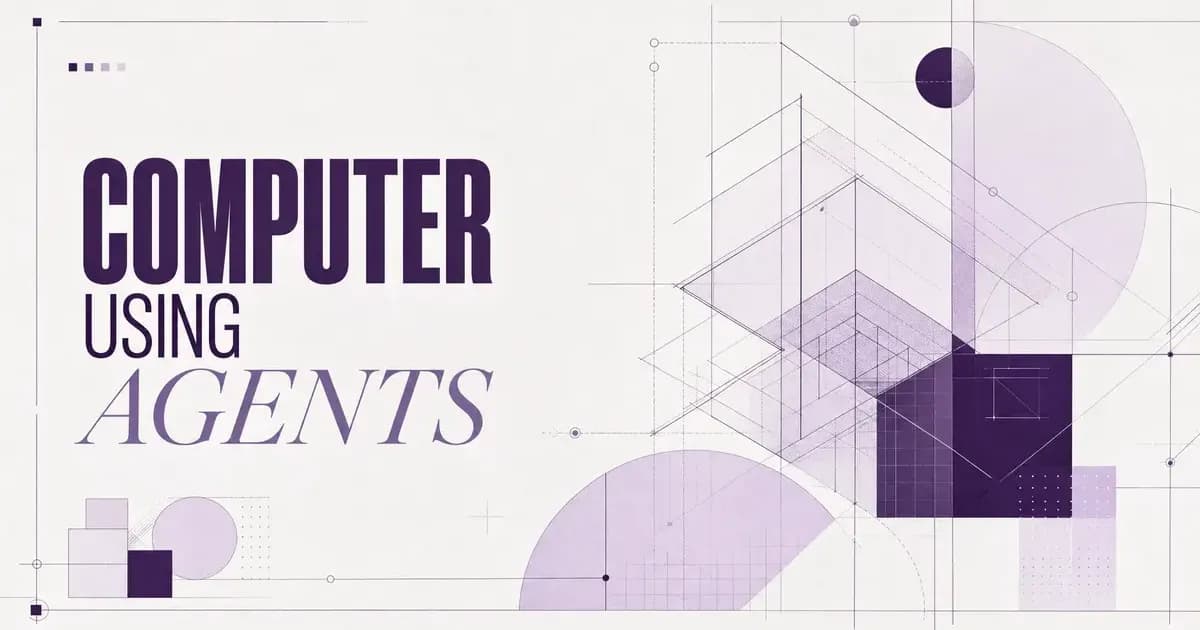
Beyond APIs: How "Computer-Using Agents" (CUAs) Are Automating Legacy Systems
For years, workflow automation followed a simple rule: if there isn't an API, you can't automate it.
If you wanted to sync data between a modern CRM and a legacy accounting system built in 2005, you had to hire developers to write custom scraper scripts, pay for expensive middleware, or force an administrative assistant to manually type the details between screens. In the enterprise world, legacy software has remained the biggest blocker to operational speed.
But in 2026, the rules of automation have fundamentally changed.
Enter Computer-Using Agents (CUAs). Powered by visual-reasoning models, these agents don't rely on APIs. Instead, they interact with computers the exact same way humans do: by looking at the screen, moving the cursor, clicking buttons, and typing text.
At zerotoai, we help founders automate the "unautomatable" parts of their business. This guide explains how CUAs work, why they are disrupting RPA (Robotic Process Automation), and how to deploy them in your business.
What is a Computer-Using Agent?
A Computer-Using Agent is an AI agent equipped with vision capabilities that can interact directly with an operating system's graphical user interface (GUI).
Instead of sending structured payloads to an API endpoint, a CUA:
1. Takes a Screenshot: Captures the current state of the desktop or web browser.
2. Analyzes the GUI: Identifies elements like input boxes, buttons, text fields, and dropdowns.
3. Plans the Action: Determines the coordinates of the target element (e.g., the Submit button).
4. Executes the Input: Moves the virtual mouse, clicks the button, or types text into the active field.
5. Verifies the Result: Takes a new screenshot to ensure the screen updated correctly.
For example, if you tell a CUA to "Log into our client portal, search for invoice #540, download the PDF, and upload it to Google Drive," it will navigate the browser, fill out the login fields, click the download icon, and complete the task visual-element by visual-element.
CUA vs. Traditional RPA: The Intelligence Leap
Robotic Process Automation (RPA) tools like UiPath have been around for years. However, traditional RPA is notoriously fragile. If a website changes its layout by a single pixel, moves a button, or opens a promotional pop-up, the RPA script breaks instantly.
Why CUAs are replacing RPA in 2026:
• Visual Adaptability: Because CUAs use reasoning models (like OpenAI's visual Operator), they understand context. If a website relocates the Submit button from the left side to the right, the CUA visually finds it and proceeds.
• Error Recovery: If a CUA clicks a button and nothing happens, it reads the error message on the screen (e.g., "Password must include a number"), reasons through the problem, and adjusts its inputs.
• Zero Integration Cost: You don't need to request API access, configure OAuth tokens, or write custom webhooks. You simply give the agent a virtual desktop environment and credentials.
The Secure Deployment Blueprint
While CUAs are incredibly powerful, giving an autonomous agent access to a visual desktop requires strict security guardrails. At Zero To AI, we recommend these three principles:
1. The Isolated Sandbox
Never run a CUA on your local workstation or production server. Always run visual agents in isolated, containerized virtual environments (like Docker containers running VNC servers). If the agent goes haywire, it cannot access your local files or network.
2. Read-Only Scoping First
Before allowing a CUA to execute writes (like submitting financial forms), test it on read-only tasks. Have the agent log in, extract data, and compile report summaries. Once you verify its visual reliability, gradually grant write privileges.
3. Session Recording and Audit Logs
Every screenshot, click coordinate, and typed string must be logged. Tools like browser session recording let you review the exact steps the agent took, making it easy to audit transactions and troubleshoot errors.
Conclusion: The API Wall Has Fallen
In 2026, you are no longer limited by what your software allows you to automate. If a human can do a task by looking at a screen and clicking buttons, a Computer-Using Agent can do it too.
Stop letting legacy software bottlenecks slow down your business operations. Build the visual harness and let the agents do the clicking.
Want to build visual-automation loops for your business?
[Join our Zero To AI Advanced Program] and learn to configure and run visual desktop agents securely.
Learn to build AI workflows that handle your busywork — live sessions, real projects, zero code.
See the courseBeginner-friendly