.jpg&w=1080&q=75)
The Death of the Chatbox: Transitioning to Event-Driven n8n AI Workflows

The Death of the Chatbox: Transitioning to Event-Driven n8n AI Workflows
For the past few years, the primary interface for artificial intelligence has been the chat box. We have been trained to open a browser tab, type a prompt, copy the response, and paste it into another application. This interactive loop was a necessary starting point, but it has quickly become a bottleneck. Typing prompts into a text box is a legacy design pattern.
In 2026, the highest-leverage automation strategy is transitioning from reactive chatbots to event-driven ai workflows.
At Zero To AI, we teach operators to build systems that listen to background events, orchestrate APIs, and execute complex business operations without requiring a human to type a single prompt. This guide explores why the chatbox is holding your business back and how to build autonomous, event-driven loops using n8n.
Why Chatboxes Are Legacy Interfaces
A chatbox is fundamentally a pull-based interface. It requires a human to initiate action, supply context, and verify the output. This model introduces several operational inefficiencies:
1. The Attention Tax: If an AI needs to draft an update, a human must remember to ask it, wait for the response, copy it, open the email client, and hit send. The human remains the slow transfer protocol.
2. Lack of State: Standard chat sessions do not maintain state across external applications. The chatbot doesn't know that a payment failed in Stripe or that a user updated a deal in Salesforce.
3. Operational Friction: Because the system is disconnected from the business event stream, it cannot react in real time.
By moving the control plane from human-driven prompts to event-driven webhooks, the AI transition becomes an automated system of action.
Understanding Event-Driven Architecture
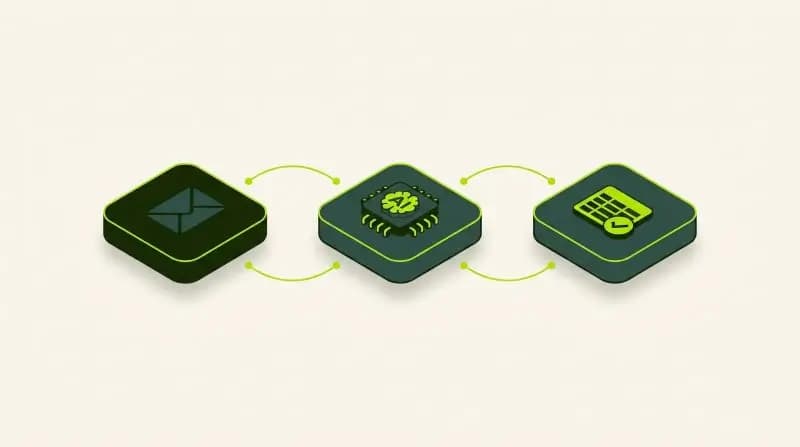
An event-driven AI workflow operates on a simple push-based model: Trigger → Orchestrate → Act.
1. The Trigger: An event occurs in an external system (e.g., a new row in Airtable, a webhook from Stripe, or an incoming email in Gmail).
2. The Orchestration (n8n): The workflow engine intercepts the event, fetches necessary historical context, and passes structured data to the LLM for reasoning or classification.
3. The Action: The system performs a write action in a downstream system (e.g., updating a CRM status, drafting a Slack alert, or generating an invoice).
This structure allows the AI to operate in the background as a digital employee, running while you sleep and only surfacing alerts at designated checkpoints.
Step-by-Step: Building an Event-Driven Workflow in n8n
To build a robust event-driven workflow in n8n, follow this structural blueprint:
1. Configure the Webhook Trigger
Start by adding a Webhook node in n8n. Configure it to listen to event payloads from your primary systems (such as a Stripe payment success or a typeform submission). Ensure that the trigger node captures the raw JSON schema.
2. Isolate LLMs to Decision Nodes
Do not let the LLM manage the entire routing of the workflow. Use deterministic n8n nodes (like the IF or Switch node) for routing, and reserve the LLM for cognitive decision points, such as classifying a customer's support intent or summarizing an invoice.
3. Maintain State with Airtable
Store the workflow execution state in a database like Airtable. Create columns for Status, Current Step, and Payload Data. This allows you to track progress across multi-step executions and resume if a step fails.
4. Build a Human-in-the-Loop Gate
For high-value write actions, send a summary card to Slack with "Approve" and "Reject" buttons. The workflow remains paused until you click approve, ensuring complete control over the system's final output.
Conclusion: The Path to Autonomy
The transition away from the chatbox is a transition from manual administration to systems supervision. By building event-driven workflows in n8n, you free your team from copying and pasting, allowing them to focus on high-level strategy and system optimization.
[Subscribe to the Zero To AI Newsletter] to receive step-by-step workflow templates and n8n blueprints.
Learn to build AI workflows that handle your busywork — live sessions, real projects, zero code.
See the courseBeginner-friendly