.jpg&w=1080&q=75)
The Quantum Bridge: IBM and ETH Zurich’s Plan to Scale GenAI Beyond Classical Logic in 2026

The Quantum Bridge: IBM and ETH Zurich’s Plan to Scale GenAI Beyond Classical Logic in 2026
As LLMs reach trillions of parameters, the Memory Wall and traditional silicon scaling are beginning to plateau. The solution isnt just more GPUs'—it’s a fundamentally different way of computing. Today, the IBM ETH Zurich Quantum AI 2026 announcement marks the first industrial-scale attempt to bridge quantum processors with today’s Generative AI workloads.
For the IBM ETH Zurich Quantum AI collaboration isnt just an academic exercise; it’s the launch of the Reasoning-to-Logic phase of the AI gold rush. Quantized models are about to get a whole lot more literal.
Why Classical Silicon is Hitting the Wall in 2026
Traditional binary processors (CPUs and GPUs) are incredibly good at massive parallel math—the kind required to predict the next word in a sentence. However, they struggle with high-dimensional logic'—problems where the number of variables grows exponentially, such as protein folding, financial risk modeling, or multi-step agentic reasoning.
The IBM ETH Zurich Quantum AI collaboration aims to offload these low-probability, high-complexity logic checks to quantum processors (QPUs), while the training and heavy lifting remain on classical GPUs.
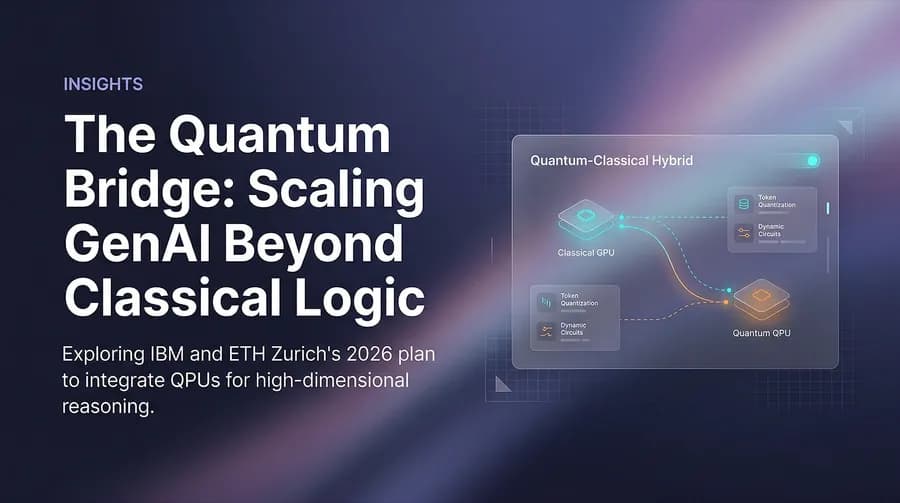
The Quantum-Classical Hybrid Architecture
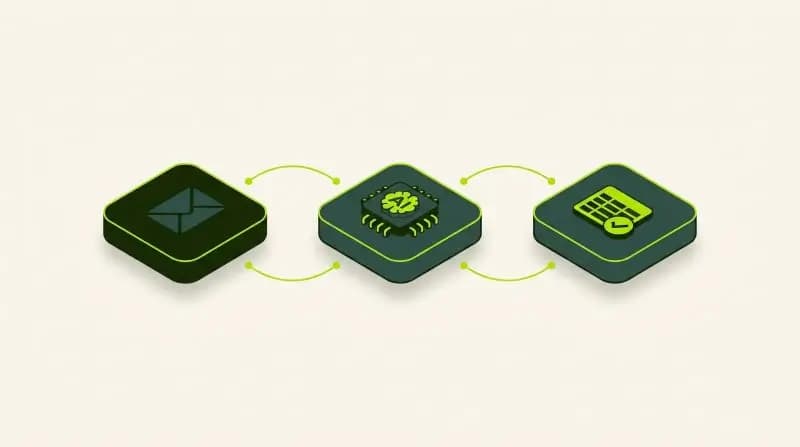
Instead of replacing GPUs, IBM’s new Quantum-Classical Bridge works like a specialized accelerator. Think of it as a Logic GPU. It doesnt process pixels or tokens; it processes probabilities.
- Quantum Error-Correction: ETH Zurich’s role is primarily in the software layer, focusing on Dynamic Circuits that allow the AI to self-correct reasoning paths in real-time.
- Token Quantization: By using quantum entanglement, researchers are finding ways to store 10x more information in a single quantum token than a traditional digital one.
Key Takeaway: The IBM ETH Zurich Quantum AI partnership is building the infrastructure that will allow 2027-era models to solve problems that would take todays supercomputers 1,000 years to calculate.
What this means for Zero To AI Business Leaders
You dont need to be a physicist to profit from this shift. But you do need to understand how Quantum-Ready your current data stack is. If youre building in 2026, you should be preparing for the Post-Silicon Reasoning era.
Algorithmic Resilience: Are your AI agents flexible enough to incorporate new logic layers?
Data Governance: Quantum AI will require hyper-accurate, verified data sets—the kind we emphasize in our Ending AI Slop framework.
Conclusion
The death of prompt engineering is being accelerated by the birth of quantum-native reasoning. The IBM ETH Zurich Quantum AI 2026 deal is the first sign that the Post-GPU era is closer than we think.
Stay ahead of the curve. [Subscribe to Zero To AI Deep Tech Insights] to track how Quantum-GenAI is redefining the enterprise landscape.
Learn to build AI workflows that handle your busywork — live sessions, real projects, zero code.
See the courseBeginner-friendly