.jpg&w=1080&q=75)
LangGraph vs. Mastra: Which Stateful Agent Framework Should You Choose?

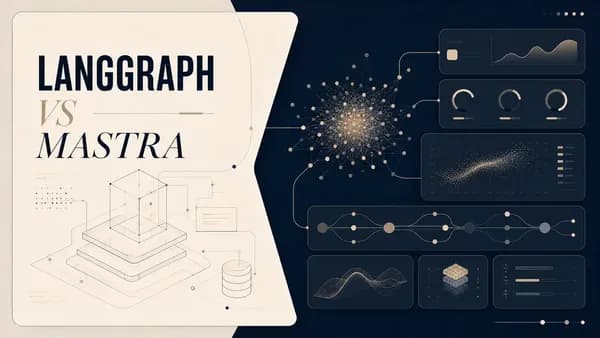
LangGraph vs. Mastra: Which Stateful Agent Framework Should You Choose?
When building multi-agent systems, the biggest challenge isn't prompt length or LLM reasoning speed—it's state management.
If you are building an agent that drafts a marketing report, runs it through an auditor, corrects errors in a loop, and saves the final result to a database, you need a framework that can pause execution, remember variables across hours, handle branching logic, and recover from failures. You need a stateful agent engine.
For the last two years, LangGraph has been the default choice for stateful, cyclic agent design. But in mid-2026, a new contender has emerged: Mastra.
At zerotoai, we help developers choose the right tool for their production stacks. This comparison breaks down the architecture, developer experience, and performance of LangGraph vs. Mastra to help you decide.
LangGraph: The Graph-First Powerhouse
LangGraph treats your workflows as state machines. You define nodes (which execute code or call models) and edges (which control the transition logic).
Key benefits of LangGraph:
• Cyclic Flows: LangGraph was built from the ground up to support loops. If your agent needs to repeat a task until it meets a specific quality threshold, LangGraph handles the cycles natively.
• Granular State Management: The state is defined as a central schema (e.g., using Pydantic) that nodes update incrementally. You have complete, code-level control over how state merges.
• Mature Ecosystem: It integrates seamlessly with the entire LangChain ecosystem, including LangSmith for tracing, debugging, and evaluation.
The trade-off? LangGraph has a steep learning curve. The graph-definition syntax can feel verbose, and managing memory databases for long-term persistence requires significant boilerplate code.
Mastra: The Lightweight, Type-Safe Challenger
Mastra approaches agent design from a modern, developer-first perspective. Instead of drawing complex cyclic graphs, Mastra focuses on lightweight declarative agent manifests and strict type safety.
Key benefits of Mastra:
• Zero-Boilerplate Setup: Mastra minimizes the plumbing. You can define an agent, equip it with tools, and run a stateful loop in just a few lines of clean Python.
• Built-in Tool Integration: It is designed specifically for tool-use (function calling) environments. Binding API libraries and database connectors to your agents is plug-and-play.
• Native Memory & Tracing: Unlike LangGraph, which requires external setups for production storage, Mastra has a built-in lightweight database layer to handle agent memory and execution history out of the box.
The limitation? Mastra is less suited for highly complex, multi-layered branching graphs with custom thread-merging logic. If your workflow resembles a massive web of decision trees, the graph-first approach of LangGraph remains superior.
LangGraph vs. Mastra: Feature Comparison
Feature | LangGraph | Mastra |
|---|---|---|
Architecture | Cyclic Directed Graphs | Declarative Workflows & Tool Bindings |
State Management | Centralized, user-defined state schema | Automatic context passing |
Ecosystem Maturity | High (backed by LangChain) | Medium (rapidly growing) |
Boilerplate Code | High (verbose setup) | Low (clean, concise) |
Built-in Memory | Requires configuration | Plug-and-play local storage |
Developer Focus | Graph architects & system engineers | Backend developers & SaaS builders |
The Verdict: Which Should You Choose?
• Choose LangGraph if: You are building enterprise-grade, complex agent networks that require precise control over cyclic feedback loops, multi-thread execution, and custom state synchronization.
• Choose Mastra if: You want to build and deploy lightweight, tool-using agents quickly. If your goal is to wire up database calls and automate operational tasks without wrangling complex state-machine code, Mastra’s developer experience is hard to beat.
At the Zero To AI labs, we recommend starting with Mastra for quick operational automations, and graduating to LangGraph if your workflow logic requires custom cyclic reviews.
Ready to write your first stateful agent loop?
[Enroll in our Zero To AI Multi-Agent Frameworks Course] and build hands-on projects in both LangGraph and Mastra.

Learn to build AI workflows that handle your busywork — live sessions, real projects, zero code.
See the courseBeginner-friendly