.jpg&w=1080&q=75)
LLM Distillation Simplified: How to Train 3B-7B Custom Models for Enterprise Automation

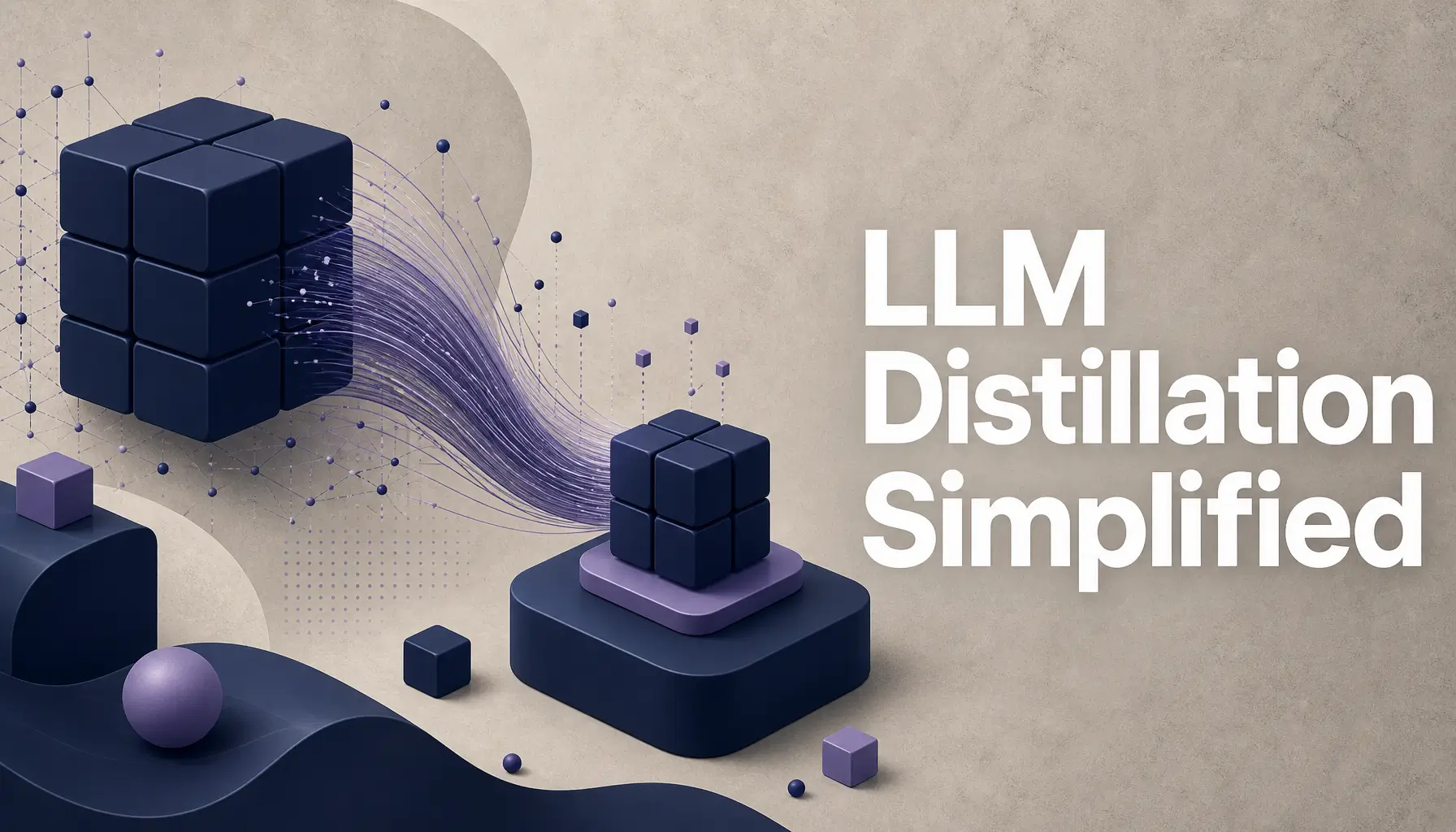
LLM Distillation Simplified: How to Train 3B-7B Custom Models for Enterprise Automation
In the early days of enterprise AI deployment, companies faced a frustrating dilemma: pay millions of dollars annually in cloud API fees to query a 1-Trillion parameter model, or settle for a generic open-source model that frequently failed to follow complex internal business rules.
In 2026, Knowledge Distillation has unlocked a middle path.
By transferring the reasoning patterns, domain expertise, and formatting habits of a massive "Teacher" model (like Claude 3.7 or GPT-4o) into a compact 3B to 7B parameter "Student" model (like Llama 3.2 3B or Qwen 2.5 7B), enterprise teams can deploy hyper-specialized local models that match frontier performance at less than 1% of the operating cost.
At Zero To AI, we help companies fine-tune and distill custom models for local production deployment. In this guide, we simplify the LLM distillation process, explain the Teacher-Student architecture, and provide a step-by-step pipeline blueprint.
1. What is LLM Knowledge Distillation?
Knowledge Distillation is a machine learning compression technique where a smaller model (the Student) is trained to replicate the output behavior, logit probabilities, and step-by-step reasoning steps of a larger, highly capable model (the Teacher).
┌───────────────────────────────────────────────────────────┐
│               Teacher Model (Frontier 1T+)                │
│    (e.g., Claude 3.7 Sonnet / DeepSeek R1 Reasoning)      │
└─────────────────────────────┬─────────────────────────────┘
                              │ Generates High-Quality Synthetic
                              │ Synthetic Datasets & Reasonings
                              ▼
┌───────────────────────────────────────────────────────────┐
│          Dataset Curation & Preference Filtering          │
│            (Structured JSON / Cleaned Prompts)            │
└─────────────────────────────┬─────────────────────────────┘
                              │ Supervised Fine-Tuning (SFT / LoRA)
                              ▼
┌───────────────────────────────────────────────────────────┐
│              Student Model (Target 3B–7B)                 │
│      (Fast, 100% Private, Deployable on Edge Silicon)     │
└───────────────────────────────────────────────────────────┘
2. Why Distillation Outperforms Generic Fine-Tuning
| Metric / Dimension | Raw Fine-Tuning (SFT) | Knowledge Distillation Pipeline || :--- | :--- | :--- || Data Requirement | 100,000+ Human-Labeled Records | 1,000 – 5,000 Teacher Synthetic Records || Reasoning Transfer | Low (Learns surface syntax only) | High (Transfers step-by-step reasoning chains) || Training Time | Days / Weeks on Cloud Clusters | Hours on a single local GPU via Unsloth/LoRA || Operating Cost | High | Near Zero (Runs locally post-distillation) || Task Accuracy | 82% on specialized domain | 96%+ matching Teacher performance |
3. The 4-Step Enterprise Distillation Pipeline
Step 1: Teacher Dataset Generation
Prompt your Teacher model to process your domain inputs and emit structured reasoning trajectories alongside final answers:
import openai
import json

client = openai.OpenAI()

def generate_teacher_sample(domain_input: str) -> dict:
    """Generate high-quality reasoning and output trajectory from Teacher LLM."""
    prompt = f"""
    You are an expert Enterprise Billing Auditor. Analyze the following transaction log and provide:
    1. Step-by-step reasoning analysis
    2. Final audit judgment as valid JSON

    Input Log: {domain_input}
    """

    response = client.chat.completions.create(
        model="gpt-4o",
        messages=[{"role": "user", "content": prompt}],
        temperature=0.2
    )

    return {
        "instruction": prompt,
        "teacher_output": response.choices[0].message.content
    }
Step 2: Quality Filtering & Data Cleansing
Filter out any incomplete Teacher outputs, hallucinations, or malformed JSON syntax. Retain only top-percentile quality responses.
Step 3: Parameter-Efficient Fine-Tuning (LoRA / QLoRA)
Fine-tune your Student base model (e.g., Llama-3.2-3B-Instruct or Qwen2.5-Coder-7B) using Parameter-Efficient Fine-Tuning tools like Unsloth or Hugging Face PEFT. This requires updating less than 1% of the model parameters.
Step 4: Quantization & Ollama Export
Export your distilled model weights into GGUF format (Q4_K_M or Q8_0) and deploy directly to your local Ollama runtime:
# Create custom Ollama model from distilled GGUF
cat <<EOF > Modelfile
FROM ./distilled-enterprise-billing-7b.gguf
PARAMETER temperature 0.1
SYSTEM "You are a specialized Enterprise Billing Auditor model."
EOF

ollama create billing-auditor-7b -f Modelfile
Conclusion: Own Your Custom Model Weights
Knowledge distillation democratizes state-of-the-art AI. Rather than remaining dependent on cloud APIs, enterprise teams can capture frontier reasoning capabilities and lock them into lightweight 3B to 7B models that run privately on their own hardware.
At Zero To AI, we guide development teams through custom dataset curation, LoRA fine-tuning, and local model deployment.
Ready to Train Your Custom Local AI Model?
Explore distillation code repositories, dataset templates, and fine-tuning tutorials at Zero To AI. Build your custom AI model today!
Learn to build AI workflows that handle your busywork — live sessions, real projects, zero code.
See the courseBeginner-friendly