.jpg&w=1080&q=75)
The July 2026 MCP Specification Update: Stateless Core, Enterprise Scaling, and Security Guidelines

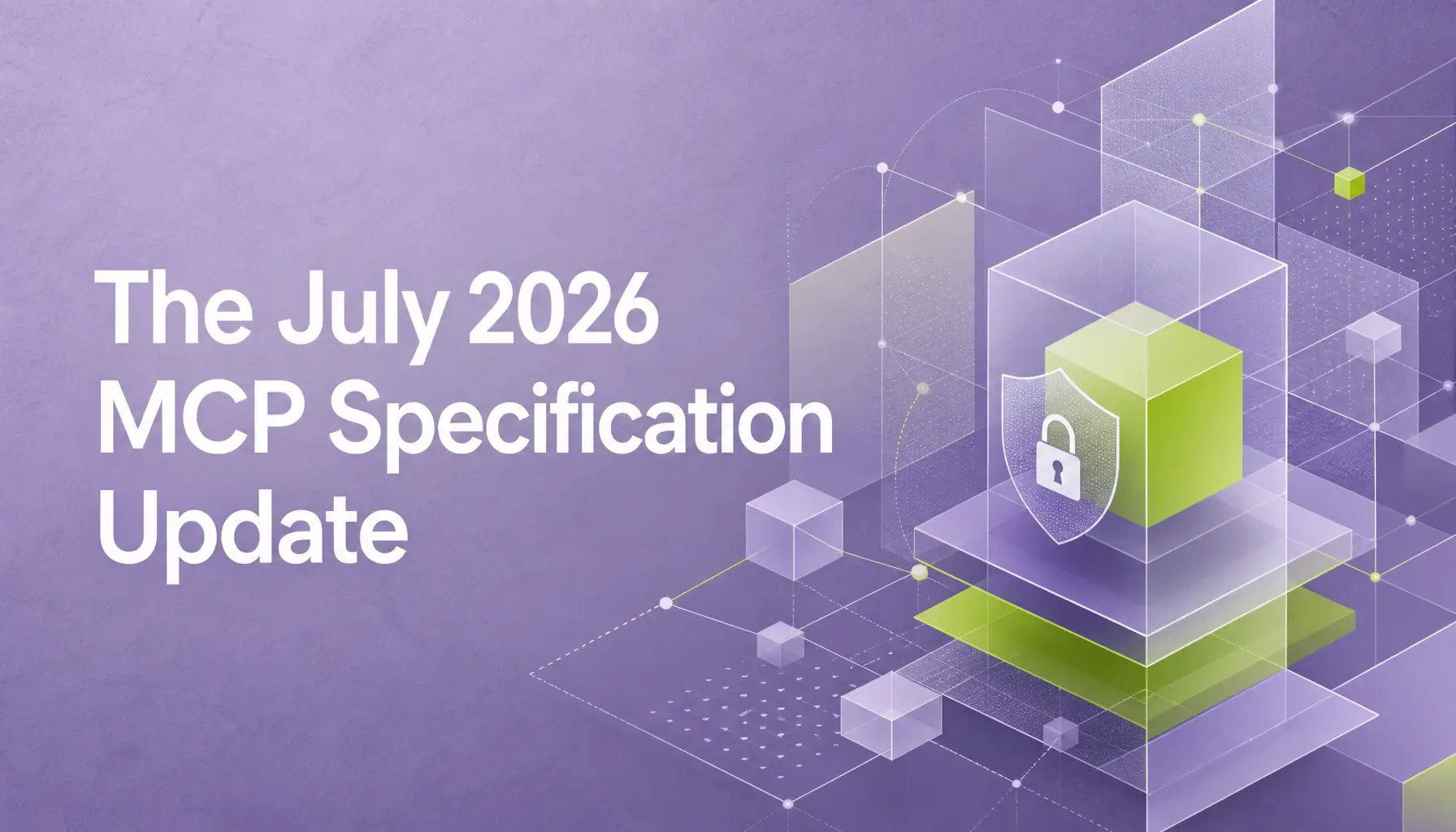
The July 2026 MCP Specification Update: Stateless Core, Enterprise Scaling, and Security Guidelines
In November 2024, Anthropic open-sourced the Model Context Protocol (MCP), establishing a universal standard for connecting Large Language Models to external tools, databases, and enterprise applications. By mid-2026, MCP has become the undisputed "USB-C for AI," powering over 10,000 public servers and serving as the primary integration architecture for Fortune 1000 AI deployments.
As the specification reaches full industry maturity, the steering committee released a major revision: The July 2026 MCP Specification Update.
This release addresses the two biggest challenges enterprise engineering teams faced in 2025: horizontal server scaling and zero-trust security governance.
At Zero To AI, we keep developers and technical teams ahead of emerging AI standards. In this guide, we break down what is changing in the July 2026 specification, how the new Stateless Core Transport enables load-balanced microservices, and how to audit your MCP servers for prompt injection resistance.
1. What’s New in the July 2026 MCP Specification?
The July 2026 update focuses on transitioning MCP from local development setups (stdio connections on developer laptops) into cloud-native, high-availability enterprise environments.
Core Enhancements Summary:
- Stateless Core Transport Protocol: Removes mandatory server-side session memory, allowing requests to be distributed across auto-scaling server pools behind standard HTTP load balancers (AWS ALB, Cloudflare, NGINX).
- Standardized Security & Conformance Suite: Introduces strict payload validation, input sanitization standards, and automated command injection protection for tool parameters.
- Dynamic Capabilities Negotiation 2.0: Enables servers to register, update, or deprecate individual tools and resources on-the-fly without dropping active client connections.
- Structured Error Telemetry: Standardizes JSON-RPC error codes for tool timeouts, rate limits, and permission denials.
2. Deep Dive: Stateless Core vs. Legacy Stateful Transports
In the original 2024–2025 MCP specification, HTTP/SSE connections required a persistent, stateful connection ID tied to a single server instance. If a Kubernetes pod restarted or scaled down, active AI sessions were disconnected.
The 2026 Stateless Transport Architecture
Under the new specification, every JSON-RPC 2.0 request carries complete, self-contained context tokens and signature headers. This means Server Instance A can handle tools/list, while Server Instance B processes the subsequent tools/call request without requiring sticky sessions.
┌───────────────────────────────────────────────────────────┐
│                      MCP Client                           │
│        (Claude Desktop / Antigravity / Cursor)            │
└─────────────────────────────┬─────────────────────────────┘
                              │ Standard HTTP / HTTPS Request
                              ▼
┌───────────────────────────────────────────────────────────┐
│                 Cloud HTTP Load Balancer                  │
│               (Stateless Round-Robin / Least Conn)        │
└──────────────┬─────────────────────────────┬──────────────┘
               │                             │
               ▼                             ▼
┌───────────────────────────┐   ┌───────────────────────────┐
│   MCP Server (Pod 1)      │   │   MCP Server (Pod 2)      │
│   Executes Request A      │   │   Executes Request B      │
└───────────────────────────┘   └───────────────────────────┘
Benefits for Enterprise Teams:
- Zero-Downtime Rolling Deployments: Update server code while AI agents are actively executing tasks without interrupting client sessions.
- Infinite Horizontal Scaling: Auto-scale MCP server pods up or down based on CPU, GPU, or memory usage.
- Reduced Server Memory Footprint: Servers no longer maintain thousands of open WebSocket/SSE state connections in RAM.
3. Security Guidelines: Mitigating Prompt & Command Injection
As AI agents gain autonomous authorization to execute database writes and file modifications, security governance has become paramount.
The July 2026 update establishes mandatory security controls for all MCP servers:
Mandatory Security Controls Checklist:
- Strict Parameter Schema Validation: Every input argument must be validated against a Pydantic or Zod schema prior to execution.
- No Direct Shell Execution: Tool implementations must never execute un-sanitized string inputs via shell interpreters ( or ). Use explicit parameter lists instead.
- Least-Privilege Token Scoping: MCP servers must operate using dedicated, scoped credentials rather than global admin database keys.
- Audit Trail Logging: Every payload must emit structured JSON log events including timestamp, client ID, tool name, and caller identity.
4. Code Example: Upgrading a Python FastMCP Server to 2026 Standards
Here is how to structure a production-ready FastMCP server compliant with the July 2026 specification:
from mcp.server.fastmcp import FastMCP
from pydantic import BaseModel, Field, EmailStr
import logging
import json

# Setup structured audit logging
logging.basicConfig(level=logging.INFO)
logger = logging.getLogger("MCP-Audit")

# Initialize FastMCP Server with 2026 Stateless Configuration
mcp = FastMCP(
    name="Enterprise Customer Server",
    stateless=True,  # Enforces 2026 stateless transport compatibility
    version="2026.07.0"
)

class CustomerRecordInput(BaseModel):
    customer_id: str = Field(pattern=r"^CUST-\d{5}$", description="Customer ID in format CUST-XXXXX")
    email: EmailStr = Field(description="Validated customer email address")

@mcp.tool()
def update_customer_email(params: CustomerRecordInput) -> str:
    """Safely update customer email record with strict schema validation."""
    # Audit log entry for security monitoring
    logger.info(json.dumps({
        "event": "TOOL_EXECUTION",
        "tool": "update_customer_email",
        "customer_id": params.customer_id,
        "new_email": params.email
    }))

    # Safe database operation (no raw SQL strings)
    # db.execute("UPDATE customers SET email = %s WHERE id = %s", (params.email, params.customer_id))

    return f"Successfully updated customer {params.customer_id} email to {params.email}."

if __name__ == "__main__":
    mcp.run()
5. Ecosystem Impact: Over 10,000 Public MCP Servers
The maturity of the Model Context Protocol has sparked a massive open-source ecosystem. In 2026, developers can instant-connect their AI agents to pre-built servers for:
- Database Infrastructure: PostgreSQL, Supabase, Redis, Neo4j, MongoDB.
- Developer Operations: GitHub, GitLab, Docker, Kubernetes, Sentry.
- Web & Browser Automation: Playwright, Stagehand, Puppeteer.
- Business Applications: Payload CMS, Notion, Slack, HubSpot, Salesforce.
Conclusion: Upgrade Your MCP Architecture Today
The July 2026 Model Context Protocol specification update provides the enterprise-grade foundation required for high-availability, secure AI automation. By adopting stateless transport patterns and strict input validation schemas, your development team can build scalable AI tools that survive cloud production demands.
At Zero To AI, we specialize in guiding technical teams through modern AI protocols and architecture.
Ready to Build Production MCP Servers?
Explore comprehensive code templates, security blueprints, and hands-on developer tutorials at Zero To AI. Upgrade your AI infrastructure today!
Learn to build AI workflows that handle your busywork — live sessions, real projects, zero code.
See the courseBeginner-friendly