.jpg&w=1080&q=75)
The Multi-Agent Blueprint: Structuring Specialized Digital Teams

The Multi-Agent Blueprint: Structuring Specialized Digital Teams
In the early phases of the AI boom, developers approached problem-solving with a single, massive prompt. They tried to pack the target persona, the rules, the tools, the data, and the expected output format into a single 2,000-word block of instructions, hoping the model would execute it perfectly.
In production, this "God Prompt" approach fails consistently.
The model suffers from attention dilution—forgetting constraints, missing tool parameters, and hallucinating JSON keys because it is overwhelmed with cognitive load.
In 2026, high-performance systems use Multi-Agent System Architecture.
At zerotoai, we design distributed digital teams. This blueprint outlines how to break down complex tasks and partition them among a network of specialized autonomous agents for maximum operational reliability.
The Philosophy: Division of Cognitive Labor
A multi-agent system is designed exactly like a professional human department. Instead of hiring one person to handle marketing, database administration, sales, and design, you build a team of specialists.
Why multi-agent systems outperform single models:
• Reduced Context Window Dilution: Each agent only receives the specific system instructions, tools, and variables required to execute its immediate task.
• Targeted Model Selection: You can run different nodes using different models. Use a cheap, fast model (like Gemini 2.5 Flash) for data extraction, and a powerful reasoning model (like OpenAI o3) for compliance auditing.
• Modular Debugging: When a output breaks, you don't rewrite a massive system prompt. You simply debug the single, isolated agent node responsible for that step.
Structuring the Digital Team: 3 Essential Roles
Every successful multi-agent architecture requires at least three distinct agent roles to manage the flow of data:
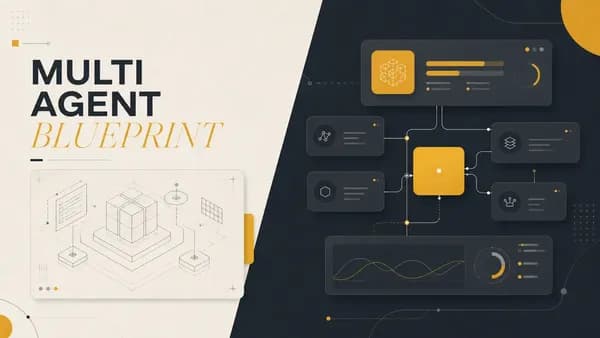
1. The Orchestrator (Supervisor)
The Orchestrator is the manager. It doesn't write code or execute database writes. Instead, it:
• Analyzes the high-level goal.
• Creates a execution plan.
• Delegates sub-tasks to the Worker agents.
• Merges outputs and manages the state transition.
2. The Domain Workers (Specialists)
Workers are execution engines. They are equipped with narrow system prompts and specific tools (like database read/write nodes, API connectors, or calculators).
• Example: A Research Worker only has access to search tools and document readers. An Outline Worker only has access to templates and structuring schemas.
3. The Auditor (Compliance Gate)
The Auditor is the quality controller. It operates under a highly critical, adversarial persona. Its job is to review the output of the Worker agents and compare it against the business rules and brand constraints. If the output fails, the Auditor sends it back to the Worker with a structured list of corrections.
How to Partition Your First System
At Zero To AI, we recommend this step-by-step partition framework for beginners:
1. Deconstruct the SOP: Write down your business process as a step-by-step flowchart.
2. Define the Handoffs: Identify the exact data payload passed between each step.
3. Assign Agents to Nodes: Replace each step with a specialized agent.
4. Enforce Loop Boundaries: Set a maximum retry limit (e.g., max 3 loops) on the Worker-Auditor feedback node to avoid runaway execution costs in production.
Conclusion: The Era of the Digital Department
In 2026, your competitive advantage isn't how well you prompt. It's how well you manage.
By structuring specialized multi-agent systems, you build an autonomous digital workforce that operates with the consistency, oversight, and reliability of a professional human team.
Ready to architect your first multi-agent team?
[Enroll in our Zero To AI Multi-Agent Architecture Program] and build stateful team networks using LangGraph and CrewAI.
Learn to build AI workflows that handle your busywork — live sessions, real projects, zero code.
See the courseBeginner-friendly